


In the first two videos I told you about the crisis: the profound impoverishment of wisdom in our modern age that afflicts even the most educated people in our society.
And, I also talked about what actually changes in a person who recovers the reading life of a Christian Humanist. Today I want to show you exactly what we are going to do together over six weeks.
First, I want to dispel a myth I suspect is sitting in the back of your mind.
You have tried making reading lists before. You purchased the books. You started journaling, but somewhere around the second or third week, life intervened and the whole project faded away. You thought you’d pick it back up again when life slowed down; but that never happened.
You may feel that you’re not disciplined enough, that you lack commitment. What you lacked was the right structure, the right community, and a guide who had been down this road before and knew where the pitfalls were. That’s exactly what The Christian Humanist Reading Life provides.
The backbone of this course is my brand new book, Becoming Classically Educated: Humane Letters on Education, Culture & the Great Conversation.
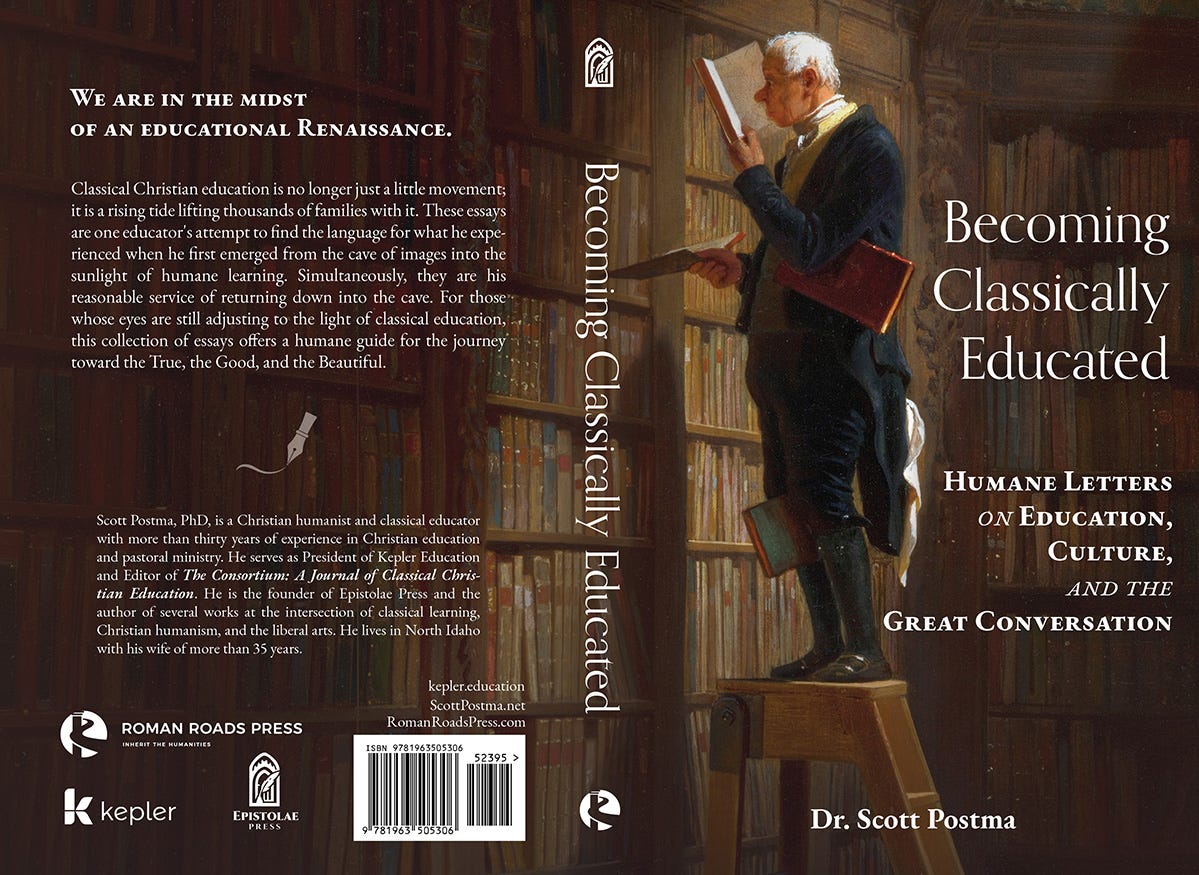
Becoming Classically Educated is a collection of essays I have spent years writing, edited into a single volume by Roman Roads Press for release next month. It is the most personal argument I have ever made for what classical Christian education actually is, why it matters now, and how an ordinary adult can begin to inhabit the tradition.
Every student in the cohort will work through this book with me, week by week, examined as a series of provocations toward, and pathways into, the Great Tradition. Most of what you read will be the essays themselves. Some weeks I will supply you with a supplementary text from one of the greats (i.e., Augustine, Lewis, Pieper, Sertillanges, etc.) to deepen the conversation. But the spine of the course is my book, and you will be the first to explore it—with the author as your guide.
Here is how the six weeks work.
Week One: What Is a Human Being For?
We begin with the question every other question is going to be built on. What kind of creature is a human being, and what is he for? Drawing on the opening essays of Becoming Classically Educated, we’ll trace the answer the classical and Christian tradition has given for two and a half millennia: that human beings are made in the image of God for wisdom, virtue, and the knowledge of the True, the Good, and the Beautiful. Week one is the anthropological foundation of everything that follows, and getting it right will set the stage for everything else.
Week Two: Live Not by Lies: Truth, the Logos, and the Life of the Mind
Modern distraction is not, as they say, a flaw, but a feature. It is a carefully engineered condition. So is modern relativism. In week two, we’ll take up the essay “Toward a More Certain Knowledge of the Truth” and ask what it means to build an intellectual life on the conviction that Truth is not a set of propositions to be mastered but a Person to be known. Together, we will build a daily reading rule—a systematic and sustainable rhythm—and you will discover that reading is not just an amusing activity but something Josef Pieper called an act of genuine leisure: a form of receptive presence that makes wisdom possible.
Week Three: Ordering the Loves
St. Augustine’s great insight is that sin is not primarily the doing of “bad things,” but it can even be the loving of good things in the wrong order. Thus, real education is the reordering of the loves. This week works through the longest and most ambitious essay in the book, tracing the concept of the good from Plato and Aristotle through Augustine’s ordo amoris to the contemporary distortions of self-actualization and therapeutic happiness. This is also the most personally confronting week of the six. You’ll map your actual loves against your intended loves, and you will begin to see clearly where formation is needed.
Week Four: Words Create Worlds: Language, Beauty, and the Liberating Arts
I’ve emphasized this before, but classical education is, at its root, a language-centered education. What do I mean by that? I mean words are instruments of communication, yes; but, more importantly, they are, in the deepest sense, constitutive of reality. Drawing on “Cosmos or Chaos: Words Create Worlds” and “Toward a Recovery of Beauty,” we will explore the way in which the liberal arts are more than an ornament on the edifice of education; rather the liberal arts are the foundation, the very disciplines by which a human being learns to perceive truth, love goodness, and recognize beauty as objective realities and not private preferences.
Week Five: Into the Great Conversation
We demystify the Great Books and I walk you through how to actually read difficult texts. How to read closely and be changed by them. You will do a guided close reading of a central text, like Plato or Dante, alongside a Christian humanist like C. S. Lewis, J. R. R. Tolkien, or Flannery O’Connor on literature as formation. That way we can experience the primary means by which the soul is trained to see goodness and beauty as real. In week five, you learn to read with your whole person, not just your intellect.
Week Six: A Rule of Life for the Christian Humanist
The course concludes with a commission. Drawing on the book’s essays on science, justice, and history, we will turn from personal formation to applied judgment; and, from there to your own vocation. You will leave with a personal Rule of Life: a document that defines your daily reading practice, your weekly intellectual disciplines, your community of conversation, and the texts you will pursue in the months ahead. I’m not just going to pump you up with inspiration; I will help you create a personal plan.
Each week includes a ninety-minute live session with me (e.g., discussions, teachings, questions, etc.), plus a short written assignment designed to move the ideas from your head into your life. The assignments are not academic exercises, per se. They are more formation practices. You will also have access to a private community space where the conversation continues between sessions. There you can share what you are reading, ask questions, and discover that you are not alone in any of this.
In closing, let me be completely honest with you. This course will not give you everything!
Six weeks is just enough time to reorient your attention, recover your love of serious reading, enter the Great Conversation, and build a sustainable Rule of Life. It is not enough to exhaust the tradition, obviously. You won’t finish all the great books or complete your personal formation. No course could do that. What it will do is give you the foundation, the practice, the community, and a book I hope you’ll return to for years as you continue the long work of personal transformation well after the six weeks are over.
The good news is that the tradition is inexhaustible. If you finish this course and want to go deeper—and most of us nerds (I mean students) do—there will be an opportunity for an advanced cohort, an ongoing community, and continued work together.
But that comes later. Right now, the question is whether you are ready to take the bull by the horns and begin.
In tomorrow’s video, I am going to tell you how to join the cohort, what the investment is, and why I am limiting this first cohort to just 13 students.
I will also answer the three objections I hear most often: “I don’t have the time,” “I am not academic enough,” and “I have tried this before and it didn’t stick.”
Watch for the video. And in the meantime, if you have a question about the course, about my new book, Becoming Classically Educated, or about whether this course is right for you, please leave it below.
I will answer you, personally.


