


Do you often come across people for whom, all their lives, a “subject” remains a “subject,” divided by water-tight bulkheads from all other “subjects,” so that they experience very great difficulty in making an immediate mental connection between, let us say, algebra and detective fiction, sewage disposal and the price of salmon, cellulose and the distribution of rainfall—or, more generally, between such spheres of knowledge as philosophy and economics, or chemistry and art?… Is it not the great defect of our education to-day (—a defect traceable through all the disquieting symptoms of trouble that I have mentioned—) that although we often succeed in teaching our pupils “subjects,” we fail lamentably on the whole in teaching them how to think? They learn everything, except the art of learning.
—Dorothy Sayers, “The Lost Tools of Learning”
Modern academic programs, even some of the better ones, are still organized around “subjects.” Not much has changed since Dorothy Sayers lamented this pedagogical deficiency all the way back in 1947. But learning “subjects” is no substitute for learning the arts of dealing with the interconnectedness of our reality, from which subjects are merely extracted or dissected.
A truly humane education is an integrated education that teaches students how to see and think about reality in all its layers and complexities such that the whole of it is much greater than all of its parts (i.e., subjects).
That’s why I am offering a new course this fall, a robust, integrated humanities course called “The Great Conversation” that spans a full six years, covering the best primary literature from antiquity to postmodernity.
The Great Conversation course is organized around the most profound perennial human questions, the very same questions that got Socrates executed, the same questions Augustine wrestled with in his Confessions, Dante mapped onto the architecture of the cosmos, and that men like Chesterton, Lewis, and Tolkien brought bravely and brightly into the twentieth century.
A Six-Year Structural Architecture
I’m inviting 12-16 students (12-13 years old) to spend six consecutive years in a single cohort where we will read, discuss, and write about the primary texts of the Western tradition in chronological order, engaging them as living voices in a long and lively conversation.
Students who take this course are committing to something bigger than their self-comfort and contemporary conveniences. They are committing to the work of securing an ultimate possession. Students who join this cohort will learn to read with increasing depth and breadth, write with increasing sophistication, reason with increasing rigor, and speak with increasing eloquence.
They will study, for instance, how beauty was conceived in Athens, transfigured in Jerusalem, encoded in the Gothic cathedral, and fragmented in the modern era. And they will do all of this together, as a community of Christians whose understanding and wisdom incrementally grows deeper precisely because the community of learners does not change from year to year.
By the time a student graduates from The Great Conversation, he or she will have read more primary texts deeply, written more substantive prose eloquently, and engaged with the perennial human questions more seriously than the vast majority of students entering America’s finest universities. More importantly, students who complete this six-year course of study will know how to think wisely and act virtuously, which is really the only kind of education worth committing six years to.
Basic Functionality
Each 32-week year is organized into four 8-week terms, covering:
Great Books (primary sources, heavily weighted)
Writing & Rhetoric (progressing from imitation to argumentation to original thesis)
Logic (formal and informal, integrated with texts)
Art & Music (chronologically synchronized with literary/historical period)
Geography, Civics, & Economics (contextualizing the civilizations being read)
Theology (Christian Scripture and theological tradition in dialogue with secular texts)
Two weekly, 90-minute Socratic Seminar component runs through all six years, modeled on the Adler'/Hutchins Paideia approach.
A reasonable annual credit allocation for such a 32-week, 3-contact-hour per week curriculum would be:
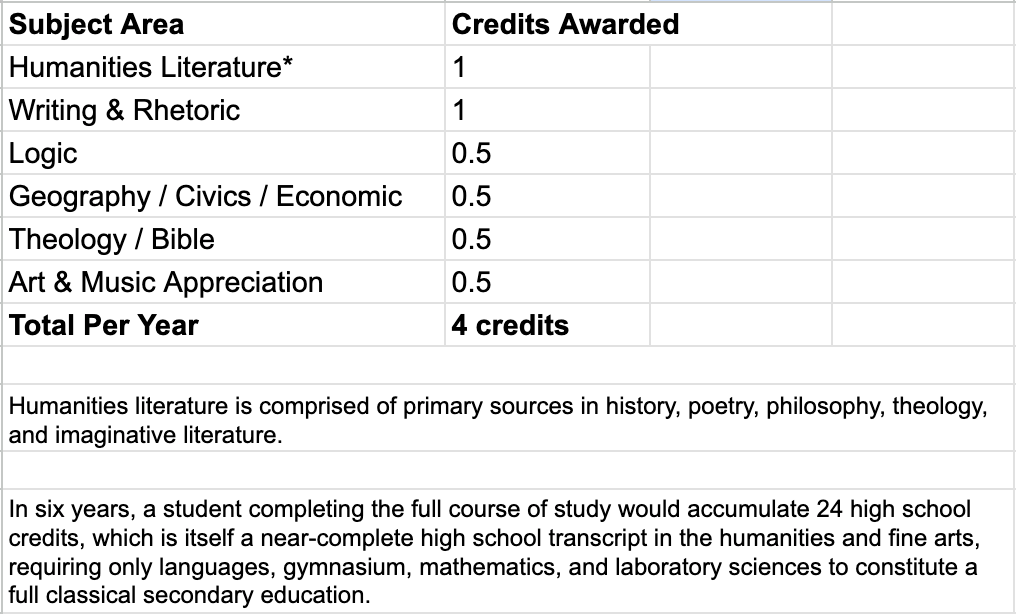
Each year will be anchored both chronologically and thematically, structured around one of the six perennial questions Mortimer J. Adler identified in his Six Great Ideas as the threads running through the whole of Western thought.
Year I - Creation, Cosmos, and the Heroic Soul
Big Idea: Truth
Ages: 12-13
Chronological Focus: Antiquity to Classical Greece
Textual Focus: Genesis, Homer, Aeschylus, Sophocles, the Pre-Socratics, Plato’s Socratic dialogues, etc.
Objective Focus: What is real, and how do we know it?
Year II - Reason, Virtue, and the City of Man
Big Idea: Goodness
Ages: 13-14
Chronological Focus: Classical Greece through Roman Empire
Textual Focus: Plato’s Republic, Aristotle’s Ethics and Politics, Virgil, Cicero, Plutarch, and the New Testament.
Objective Focus: What is virtue, and how is it cultivated?
Year III - Faith, Reason, and the City of God
Big Idea: Beauty
Ages: 14-15
Chronological Focus: Fall of Rome to the Medieval world
Textual Focus: Augustine, Boethius, Aquinas, Dante, Chaucer, and the Beowulf-poet.
Objective Focus: What is the transcendent, and how does it draw us?
Year IV - Renaissance, Reformation, and the End of Christendom
Big Idea: Liberty
Ages: 15–16
Chronological Focus: Renaissance to the Early Modern Period
Textual Focus: Erasmus, More, Luther, Calvin, Shakespeare, Milton, Descartes, Pascal, Rutherford.
Objective Focus: What is freedom, and what does it cost?
Year V - Revolution, Romanticism, and the Modern Self
Big Idea: Equality
Ages: 16–17
Chronological Focus: Early Modern to Modern Era
Textual Focus: Locke, Rousseau, Burke, The Federalist Papers, Tocqueville, Dostoevsky, Nietzsche, Kierkegaard, Freud, etc.
Objective Focus: What does it mean for all persons to bear dignity?
Year VI - Postmodernism and Cultural Recovery
Big Idea: Justice
Ages: 17-18
Chronological Focus: Modern Era to Postmodern Era
Textual Focus: Chesterton, T.S. Eliot, C. S. Lewis, Tolkien, O’Connor, Orwell, Arendt, Solzhenitsyn, Pieper, Sowell, Sartre, Heidegger, Polanyi, etc.
Objective Focus: What do we owe one another, and on what basis?
If you have a child 12-14 years old that you think would be interested, please use this button to express your interest. I would be happy to follow up.


