


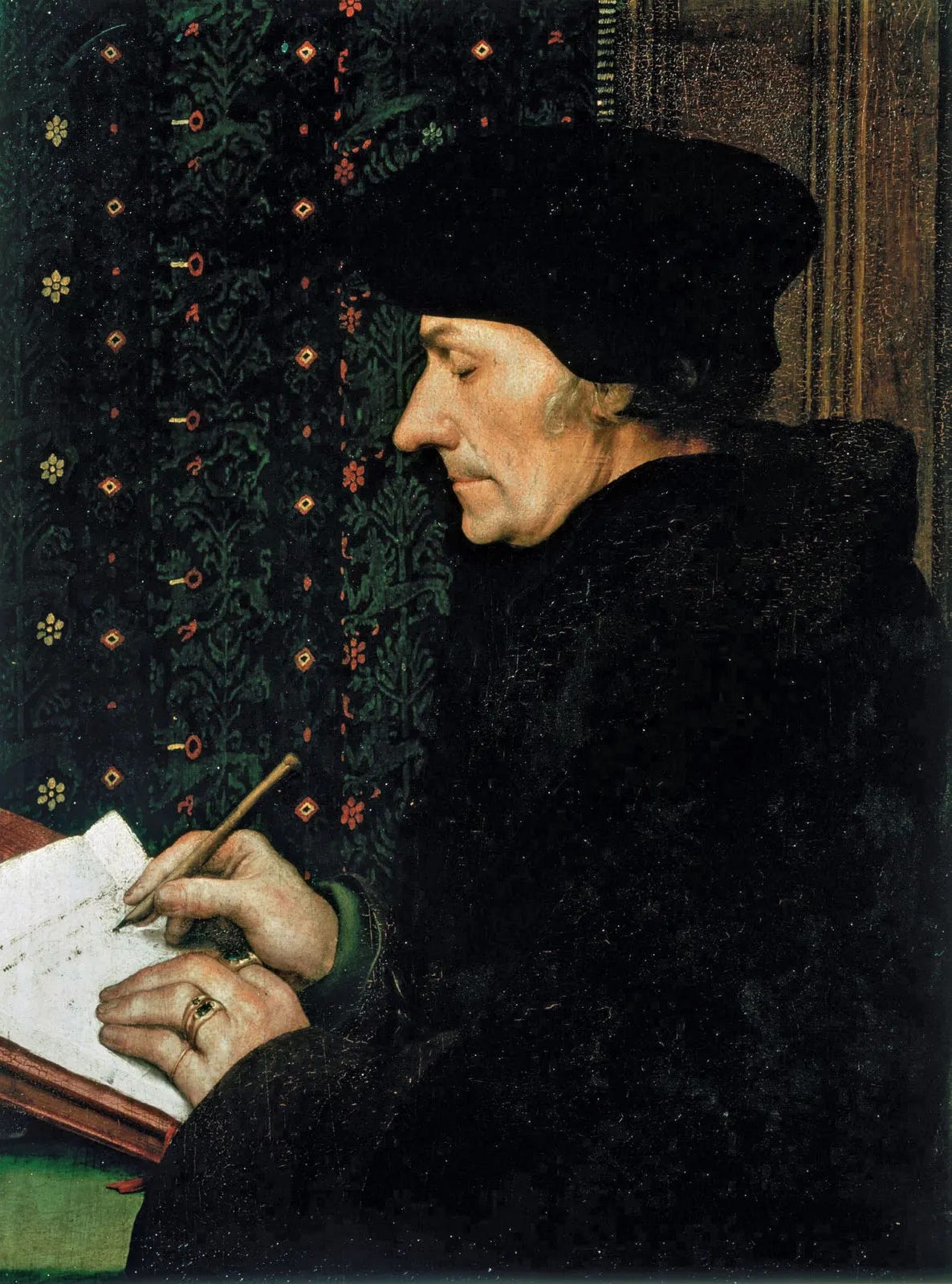
Letter 1 -Ten Pillars of Christian Humanism
Dear Mentor,
Peace be with you fellow Dutchman, wise scholar of primary sources, craftsman of satire, and beloved Prince of Humanists.
I am writing to you by my own hand from the vast swinging bridge, that suspended link between heaven and earth where mortals’ virtues are burned away in conveyance over Jordan’s stormy banks to that lush garden city of the happiest life where God himself will be, who will wipe away every tear from our eyes, and death shall be no more; neither shall there be mourning, nor crying, nor pain anymore.
May it be that we walk together and share our minds after the days of our old age on the far side of that sacred boundary where the river of the water of life, bright as crystal, flows from the throne of God and of the Lamb; and, where the tree of life is ever in bloom for the healing and refreshment of the saints.
Meanwhile, I must boldly presume upon your grace and solicit the employ of your sagacious mind regarding a work that continuously burdens my heart even while the doldrums of daily life so often impede the fulfillment of this hallowed task. I confess I have frequently sought to free myself from its miserable weight; but, try as I might, I was unsuccessful in all of my attempts to dispatch this proverbial albatross, even with my crossbow. With each attempt its noose only grew tighter around my neck.
So it was, some months back, I acquiesced and determined to wear the avian burden like a garment. Unfashionable as it may be in my present circumstance, I have heard tales of Titans who embraced similar affliction and their vexing compulsions became the darlings of posterity. One may take for preeminent examples that blind bard from Ionia, the beloved disciple of Jesus, or the venerable Bishop of Hippo.
Certainly, I am no poet. I am barely a theologian, and perhaps only a philosopher in the oldest sense of the word, a simple lover of wisdom. Although many pupils over the years have called me διδάσκαλος and umanisti, and colleagues vir litterarum, and though some notable Cancellarii and Praesides have conferred upon me the title of Doctor Philosophiae in Humanitatibus, I have to admit I’m really only a scribe, and one still in apprenticeship to bote.
So, please believe me when I tell you I have no pretensions of vainglory in pursuing this work, only a desire to nourish the logos-impoverished, and feed the albatross in the process. And while productivity in this work has so far only been achieved in the smallest of degrees (and even those small successes were only accomplished in fits and starts), I trust that I can find some measure of satisfaction if I begin by clarifying the work.
At the very least, I will know in which direction I should be digging my path. As that beloved modern muse, Annie Dillard, has instructed us,
When you write, you lay out a line of words. The line of words is a miner’s pick, a woodcarver’s gouge, a surgeon’s probe. You wield it, and it digs a path you follow. Soon you find yourself deep in new territory. Is it a dead end, or have you located the real subject? You will know tomorrow, or this time next year. You make the path boldly and follow it fearfully. You go where the path leads. At the end of the path, you find a box canyon. You hammer out reports, dispatch bulletins.
To ensure I’m digging in the right direction and sending meaningful dispatches to the most admirable of assemblies and audiences, I’m writing to request your critique of what I am coming to think of as Ten Pillars of Christian Humanism, the expanded adages I expect will guide my own digging. This is hardly a manifesto, per se; neither is it an exhaustive list of topics I mean to report on.
Rather, these ten pillars are simply statements that attempt to clarify some of the chief tenants of a renewed Christian humanism in this, my own, unique age. The goal is to articulate these comprehensive ideas that will require some extensive unpacking in statements concise enough to be memorable, yet accurate enough to be remarkable.
The meaning contained in each of these statements is far more sophisticated than they might seem prima facie. I suspect, in some cases, their meaning is inexhaustible. Yet, all of these issue from one fountainhead: the Incarnation of the Logos, that historic event through which our most majestic creator and Triune God communicates, interacts, and redeems the world.
Without further delay, please consider these following ten pillars of Christian humanism—and please, by all means, as you did with More, Colet, Vives, Batt, and even Luther, provide me with your sincerest and ablest critiques:
The Incarnate Logos is Lord of every square inch of the Cosmos. His name is Jesus and he is the Christ.
Christianity has ultimate purchase on the culture because the glory of God is a living man.1
An irenic theology—albeit not a compromised one—rooted in eucharistic hermeneutics is preferred to a polemic spirit of contest.
Every fundamental institution has its unique realm of authority: the Church is the recollective body of Christ charged with the ministry of Word and Sacrament; the family is the essential building block of society charged with the health, welfare, and education of its own members; and the magistrate is an elected body of executives commissioned with preserving peace and ensuring justice within society.
Western civilization offers the best model for human flourishing because Christianity animated its classical virtues and provided the authoritative means of self-critique.
Mankind is, by common grace, a sub-creator; therefore, wherever truth, goodness, and beauty is discovered, it belongs to the Logos. Those who are in Christ Jesus are God’s own ποιεμα, fallen human beings regenerated for good works.
Language is endowed with meaning, an essential component of the divine order, a conceptual bridge for conveying both divine truth and human thought; albeit, sometimes it is a complicated, at times even deficient, medium for mediating signs and their meaning.
Letters, conceived in the broadest sense (i.e., literature), are both the idéogénies and transmitters of ideas that guide, and either sustain or diminish, every civilized culture and society (Thus, Ad fontes!).
Good writing is clear thinking made visible, including poetry, which essentially is beautiful, concentrated, and superfluous language reflecting God’s most creative and generous impulses.
Education is an ultimate possession and, with human flourishing as its aim, its activity is the transmission of our cultural inheritance from one generation to the next.
Indeed, dear Mentor of Rotterdam, my attempt to supply some supporting pillars for a Christian humanism in what is now a post-modern age may seem overly ambitious, but as has been widely acknowledged, the man who aims his bow at nothing hits his mark every time.
I humbly welcome your gift of insights and corrections; for the man who receives instruction and/or correction is better off than he who supplies it. It is a gift and blessing to him who receives it in humility.
As I eagerly await your reply, I will occupy myself with further reading and research so that I may have somewhat intelligent responses to your gracious but exacting critiques.
Yours, most sincerely,
Agapetos Mathetes
Letter 2 - On The Reformation
Dearest Desiderias,
May the peace of Christ be upon you beloved Prince of Humanists.
Omnis gloria Deo for your most gracious epistle. Receiving your reply to my previous letter was balm to my weary soul. In a fit of melancholy, I had nearly resigned myself to believing I would never hear from you again, either because of our geographical distance or some exorbitant demands on your time—or, heaven forbid, one of those odious rumors of your untimely and mysterious demise were true. I’m ecstatic to be wrong on all counts. Your words have, once again, elevated my soul and given me heart.
Thank you for your kind and candid thoughts on the 10 Pillars For A New Christian Humanism I shared with you in my last letter. I will ruminate on your measured critiques and consider their application to this ambitious project. I am also taking your pointed warnings seriously, as you have urged me to do, especially the temptation to hold up Christ’s lordship as merely an intellectual axiom. God forbid! As your own philosophia Christi was that of simple piety and not any kind of ideological system, you have given me a faithful model I will strive to emulate. For that gift, I am deeply grateful to you.
Too, I will remember your wise admonition that kindness cannot supplant truth and that consensus is to be cherished over compromise. Furthermore, I will, when controversy arises as it did for you with Luther, let my arguments be candid but gentle just as you have advised me. I want you to be assured that I heartily agree with your wise assertion, which is just as important in my own day as it was in yours, to strive for unity rather than uniformity, all the while holding firm to the Apostle’s tradition.
Of course, I must humbly beg your pardon for so many careless assumptions I made previously. I should have been more mindful of the complexity of changes that have occurred since your prolific days of publication. No wonder you were perplexed at some of my statements and terms. Post-modern, for instance, describes the philosophical condition of the West now that secular humanism—with its emphasis on pure reason and its eschewal of religion—has run its course, a condition that had barely begun to take root in Rome and Florence when you were writing. In many ways, this post-modernism accounts for our current cultural malaise, a prevalence of nihilism and dysphoria. I would unsettle you with the numerous anecdotes, but I must not divert too far from my purpose in writing this letter.
I’m sure you will be surprised when I tell you, dearest Mentor, that many of your works are still being read today, especially Adagia, Colloquia Familiaria, and Encomium Moriae. And that doesn’t begin to account for the posterity of your Novum Instrumentum, which I shall say more about in due time. I inform you of this because you should know the effect your works have had on the entire Western world, a real Parnassus if you will refuse the impulse to believe I am merely flattering you. You will either be ecstatic or disconsolate to know still, all these years later, you are arguably the most notable, prolific, and influential scholar of the sixteenth century, both on the continent and in England. On one hand, your life’s work succeeded in manifesting the kind of Renaissance you and your beloved friends hoped to facilitate; but it also activated a revolution so significant that it set all of Europe on fire and turned the world upside down.
Your embittered exchanges with Luther? Your need to move from Basel to Freiburg im Breisgau? These were only the beginning of a reform movement that would not only prompt the papacy (Pope Paul IV) to place your opera omnia on the Church’s Index Librorum Prohibitorum in 1559—more than twenty years after you ascended to your heavenly reward—but also forever changed the landscape of Christendom. Oh, yes, dear Mentor, those theological debates grew Gargantuan, larger and more grotesque than even your brilliant mind could possibly imagine. Even though you adamantly preached reform from within; it was not to be! Unwittingly, I’m sure, you nevertheless participated in opening Aeolus’s bag of winds, the storms of which were unleashed on the complex webs of the Church and State politics of your day. And, of course, Luther’s intransigence (and hot temper) solum oleum in caminus addidit.
There is so much more I desire to tell you about the nearly five hundred years that have passed between us, but the changes are so monumental you would hardly recognize your beloved Europe, even our own vaderland. As you were acutely aware even then, the trajectory of the Italians sadly turned what was shaping up to be the most beatific renaissance of art and letters since Charlemagne into an unprecedented order of anti-theism. For my own part, you may be intrigued to know that four hundred years after you lived in lowlands, mijn overgrootvader emigrated from Amsterdam to a nation that did not yet exist during the days of your burgeoning renewal. It is a nation that was established in Amerigo Vespucci’s “New World,” largely as a result of this Reformation your works helped ignite.
That work into which you most invested your heart, your Novum Instrumentum, which Frobenius published for you in 1516… Well, it would become an incendiary touchstone and the very basis for this Reformation of which I speak. Luther, as you well know, used it to translate his German New Testament in 1522. And perhaps you heard news of the English scholar by the name of William Tyndale. Certainly, you must have, even though he was nearly thirty years your junior if my memory serves me accurately. He studied at Cambridge just after you lectured there and was heavily influenced by the legacy of your dear friend, John Colet. In any case, this good man, Tyndale, was zealous for the gospel and in 1526 he translated your New Testament into his English vernacular. Unfortunately, he would pay for this “error” with his life the same year you also departed for the heavenly shores.
Ah, dear Mentor of Rotterdam! How can even Mount Vesuvius compare to the upheaval and change your Novum Instrumentum made on the world. Time and ink are too expensive to elaborate any more on this point now. It will have to be saved for another time. To summarize briefly, since I’ve undoubtedly shocked and frightened you with so many details. Suffice it to say your controversial magnum opus, matchless in its time, became the seedbed for what would to become known as the Textus Receptus, a work that served as the donor text for many new translations that were soon to follow: the Geneva Bible (1560), the Bishop’s Bible (1568), and King James’ Authorized English Version (1611). These all played their magisterial part in the Reformation that swept the Western world.
Good heavens, do pardon my digressio. How I have managed to occupy your precious time with details far beyond my initial intentions. Yet, I beg your indulgence for another letter that must soon follow, seeing there is still so much to tell you. And, nevertheless, allow me to conclude my current lengthy epistle with an explanation as to where I have been forced to land on my feet in the current theological landscape.
Although I must disappoint you, and perhaps only by visiting our current state of affairs for yourself would you begin to understand my reasons, I must confess to being a Protestant, however careless I am for the label. If it were possible I would prefer to be called simply Christian; or, if need be, I would prefer Reformed Catholic, seeing I hold most sincerely to the true faith that was first delivered to the saints by our Lord and propagated by his apostles. Regrettably, even these descriptions themselves carry so much baggage due to all the historical wrangling, we must ever spend our days defining terms. To be sure, I find the most confidence for the status of my communion in Christ’s society in the language of our ancient brother, Saint Vincent of Lérins, who wrote in the Year of our Lord 434:
In the Catholic Church itself, also, great care is to be taken that we hold that which has been believed everywhere, always, and by all: for that is truly and properly Catholic,2 as the very meaning and derivation of the word show, which embraces all as nearly as may be universally. This we shall only then do, when we follow Universality, Antiquity, Consent. Universality we follow, by confessing that to be the one true faith, which the whole Church throughout the world professes. Antiquity, by in no wise receding from those senses which it is manifest that our holy elders and fathers generally held. Consent, in like manner, by adopting, in antiquity itself, such definitions and opinions as have been held by all, or at any rate, almost all, the priests and doctors together.3
I will expound on my own position more thoroughly in future correspondence but I can only hope to console you with the knowledge—for I expect you are greatly disappointed—that despite the bloody strife that occurred in the body of Christ in the subsequent years, many necessary reforms were achieved. Furthermore, you may be heartened to know that currently bits of conciliatory progress are slowly being made as well. For example, in the Year of our Lord 1999, A Joint Declaration on the Doctrine of Justification was established between the Roman Church and the Lutheran Church. I pray it is only the beginning of what a new Christian humanism would help foster.
I am perhaps most enthusiastic at this time about a modern renaissance in education and letters that is emerging amongst all three of the traditions represented in our day: Orthodox, Roman, and Protestant. Although distinct views on essential doctrines remain calcified within the ranks of our current communions, there is hope for a growing unity amongst those Christians of every tradition who are working to restore classical education. If nothing else, this ecumenical work has served to partially reclaim a humane education for the next generation while also fostering congenial conversations about our various unique distinctions. Alas! Too much discord remains.
Having full confidence in the mercy of our Redeemer that your soul has been certainly commended to God, I will, as I await your next letter, eagerly commend your wisdom to men. And if, as a confessional Protestant, I could ever muster the certainty of my Roman and Orthodox siblings, that our saintly brothers and sisters now abiding in Christ presence do, in fact, pray for us, I would ask you, Sancte Erasme ora pro nobis!
In constant hope of concord, I remain yours, most affectionately,
Agapetos Mathetes
Letter 3 - Five Goals For a New Christian Humanism
Agapetos Mathetes to the Learned and Eloquent Humanist, Desiderius Erasmus:
Most gracious Mentor, how abundant your reservoir of kindness must be, for once again you have extended your graciousness by writing to me and offering your much valued advice along with your pointed reproofs. And while I still stand by the words of my first letter, namely that it is a gift and blessing to the one who receives reproofs in humility, I must admit that I no more deserve the reproofs contained in your last letter than I did your kind praise in the first.
Nevertheless, I can tolerate your undeserved reproaches with the utmost equanimity, and that with a clear conscience. For I suspect that you are unable, from your own vantage point, to fully comprehend the full extent or nature of the current circumstances that exist this side of that event you are calling the Protestant Schism.
Certainly you are aware of the moral degradation, doctrinal innovations, and political hubris exercised by the Church in the years leading up to the Reformation. Didn’t you indicate as much in your friendly correspondence, in Querela Pacis, and even in your Colloquies? Certainly, you cannot be held responsible for your inability to know just how egregious was the hubris that followed. As a soaring bird can see the entirety of a hill better than either man who are presently sitting at the base of opposite sides, believe this bird when I tell you there were heresies and innovations dogmatized that were only speculative theology in your day. Even though you sat in closer proximity to the event than me, I am privileged with a bird’s eye view of hindsight.
As to your surprise and deep disappointment upon learning the full extent of the breach that followed your departure to that majestic court of our blessed Savior, what did you expect, beloved Mentor? Did you expect that it would effect nothing? Were Julius Exclusus and Encomium Moriae penned merely as toys? Did not the Apostle Paul, that man of God and man of letters, writing to the Ephesian Christians, extol our God for his gracious and infinite power thus: “Now to him who is able to do far more abundantly than all that we ask or think, according to the power at work within us…”
By the power of the Holy Spirit, the Christian piety you hoped your humanistic works would restore to the monasteries, to the schools, and to the Church in your own day was abundantly efficacious. Like the inseparability of the wheat and the tares, reform accompanied the folly when carnal men in holy garb hastened to break rather than heal. It is true that discord, unbathed in prayer and patience, bred division. Nevertheless, while we all sorrow for blood spilled in the name of conviction, let us also rejoice that the gospel was spread.
As for my own perspective I have attempted to remain objective to whatever extent it is possible for homo sapiens, to give credit where credit is due and to give censure where censure is due. But how arrogant would I have to be to believe I alone had any capacity to transcend this complex dispute, form the most correct position, and what? Start my own sect of followers? I would be no less deluded than those radical reformers in Munster.
What else can a man in my circumstance do but choose the better of two partially-flawed opinions? While I personally fail to find the exuberance some Protestants share in believing they have most certainly and completely aligned themselves with the indisputable truth of things as they exist, I could not bring myself to admit those innovations on which the Roman Church doubled-down and codified at the Council of Trent. Were I to fall from heaven and land on earth as a Christian in your day, likely I would have sought the Church’s much-needed reform from within.
Yet, that I might be on record for saying so, as much as I refuse to admit those innovations of the Roman church, neither do I admit those innovations of the Protestants, especially those that arise from so much of their unconscious nominalism. But these matters will have to keep for another letter, or perhaps until we walk together on the other side of that vast swinging bridge when we both see as eagles. Trust me when I say the issues are too extensive and too complicated to work out with any advantage to our purpose here.
As to your request—and I assure you, I tried to be brief and not belabor my case any further than necessary—I heretofore present you with my Five Goals for A New Christian Humanism; or, to state it more accurately, these are the five goals I would like to accomplish toward a renaissance of Christian Humanism in our post-Christian age.
Goal #1
How can I begin to convey to you just how far removed Western society is from any semblance of a Christian culture in my day? For this reason, we need to recover the very idea of Christian humanism. This is my first goal: to revitalize the expression and meaning of Christian humanism in our post-Christian culture, a culture that believes humanity can only flourish in the absence of religion, especially our beloved Christian faith. In this age of secularism, faith has been cruelly divorced from reason. Epistemology serves as a buffer between what can be known by the public and what can be believed in one’s own private affairs. If a Christian humanism is to be recovered in our age so that Christianity can, once again, receive the full consideration of its purchase on human flourishing, not only within the halls of our dysfunctional universities and schools, but also in the dissolute public square, we must first creatively reintroduce the idea to the thinking population. To achieve this goal, I am relying on those Christian humanists who did similar in their day as you did in yours. If only you could be blessed enough to know for your self the works of men like C. S. Lewis and J. R. R. Tolkien. And, would you believe it, there have even been women humanists—are you surprised? Two notable examples are women called Dorothy Sayers and Flannery O’ Connor. The former is perhaps too Protestant for your taste while the latter, a Roman Catholic, wrote in the style of Rabelais.
Goal #2
Next, we must foster even more dialogue toward reconciliation and unity (not uniformity) between the Christian traditions (i.e., Orthodox, Roman, and Protestant, etc.). This, my insightful tutor, is an enormous task, but one that is an essential tenant of Christianity itself. As you who were so sincerely committed know as well as anyone, until there is unity within “the faith that was once for all delivered to the saints,” the Church will not take its rightful place as stewards and arbiters of culture.
Yet, instead of humility, the Church exudes hubris; meanwhile Christ’s society is not taken serious by society and it remains an object of ridicule within the culture. It is quite evident that you anticipated the results of a schism, otherwise you would not have gone to such lengths to caution Luther, as well as cardinals in the Collegium, to temper their arguments. Moreover, you knew Jesus’s prayer for the Church was unity:
And I am no longer in the world, but they are in the world, and I am coming to you. Holy Father, keep them in your name, which you have given me, that they may be one, even as we are one. -John 17:11
Saint Paul, too, exhorted the church to this end:
I therefore, a prisoner for the Lord, urge you to walk in a manner worthy of the calling to which you have been called, with all humility and gentleness, with patience, bearing with one another in love, eager to maintain the unity of the Spirit in the bond of peace. There is one body and one Spirit—just as you were called to the one hope that belongs to your call— one Lord, one faith, one baptism, one God and Father of all, who is over all and through all and in all. -Ephesians 4:1–6
My faithful teacher of the humanities, I am hopeful that a recovery of Christian humanism in this age will naturally foster such a unity because, as you demonstrated in your own life’s work, Christian humanism tends to transcend dogma and polemics; instead of war, it focuses on piety through an irenic theology toward human flourishing, which our Saintly Father Irenaeus taught us is the glory of God.1
In my own era, a World Council of Churches attempted to establish a joint statement on Unity, now called the New Delhi Statement on Unity. Although I am not so naïve to believe it will be achieved in my lifetime, I do believe it elegantly expresses what I am convinced it will take to realize this unity. What follows is part of its third paragraph:
We are not yet of a common mind on the interpretation and the means of achieving the goal we have described. We are clear that unity does not imply simple uniformity of organization, rite or expression. We all confess that sinful self-will operates to keep us separated and that in our human ignorance we cannot discern clearly the lines of God’s design for the future. But it is our firm hope that through the Holy Spirit, God’s will as it is witnessed to in Holy Scripture will be more and more disclosed to us and in us. The achievement of unity will involve nothing less than a death and rebirth of many forms of church life as we have known them. We believe that nothing less costly can finally suffice....
Goal #3
My third goal for a renewal of Christian humanism is to promote a more extensive conversation on civic policies that transcend ideological frameworks that merely range from Marxism on one hand to various Nationalisms on the other. Please pardon me! I’ve done it again. How could you know what I speak of, unless I explain the terms that came into being hundred of years after you took your heavenly flight.
To provide you with the shortest possible explanation, Marxism is an ideology that arose from a German thinker called Karl Marx. He believed there could exist such a thing as a classless society, the very paradox your most genial friend, Thomas More, satirized in his Utopia. Yet, in every place that this political system has been tried—and it has been duly tried—it has, without fail, resulted in mass genocide on a scale so enormous you would not believe me if I told you. Summarily, you might conceptualize Marxism as a Christless imitation of Christian society; and without the Holy Spirit to empower generosity, equality is enforced by despotism.
Nationalisms, on the other hand, consist of variations of theocratic republics, ranging from bordered nation-states divided by racial boundaries to what amounts to coerced Christian culture. While recognizing national boundaries and legal jurisdictions are essential to preserving justice and fostering human flourishing via a sensus communis, the concern with Nationalism in our own day is the way it so often employs the ideology of a Florentine who was your contemporary, Niccolò Machiavelli—although most likely you would not have read his work, The Prince, since he did not travel in your circles. I can assure you my fellow Citizen of the World, he would have been too brutal for your wise and congenial tastes.
Christian humanism would view successful civic policies as expressions of wisdom extending from Natural Law and existing in historical secularity—that liminal space between Secularism and the various forms of Theocracy. As a Christian humanist, I can’t help but believe the ultimate manifestation of gospel dominion (Matthew 28:18-20) is a divine work of the Holy Spirit, not the work of Christian actors employing Machiavellian tactics in the political arenas. To state it most succinctly, although our second goal will be much harder work than waging culture wars, if I read Saint Peter correctly, it must take priority over the culture-warrior impulses.
Goal #4
The fourth goal, my dear man of letters, will be to reintroduce and cultivate what I am calling holistic cultural discernment. It would be difficult for you to fathom, dear Mentor, the level of disintegration that exists in our present society, especially in the universities. It’s doubtful you would even recognize the universities of my day. Their rigor is often so feeble, it would undoubtedly be overshadowed even by the soulless education of your youth at Gouda and Bois-le-Duc.
Since, as you are so keenly aware, humanists are interested in studying the artifacts humans create, particularly those symbols called letters that convey the human experience and condition, Christian humanism would promote the consideration of those artifacts and experiential aspects of the humanities through the lens of our faith, especially through the lens of the Incarnation. How else could they be valuable for the soul you are surely going to ask? In the modern world, you will be surprised to discover ideas are segregated into subjects, each distinct from the other, so that reality can only be conceptualized in fragments.
Would you even be surprised if I told you modern society has more new books printed every year than existed in the entire world when you stood annotating your great Adages? Yet, simultaneously there is such little interest in reading books that inversely proportionate to their negligence they suffer from the greatest ennui and dysphoria your beautiful mind could fein to imagine. My dear Erasmus, you would not believe me if I told you the number of youth who believe a man can become a woman and vice versa; and, if I claimed the freedom to live out that delusion is protected by the magistrate, certainly you would call me a liar or a mad man. But it is true.
One goal of another renaissance of Christian humanism will be to explore the human condition, along with our beliefs and artifacts, in an integrated fashion once again. We would dissolve the modern approach of segregating ideas into specialized fields—and I know you will upbraid me for my foolish talk when I tell you—subjects like “literary humanities” or medical humanities, or digital humanities, etc. I know you do not believe me, but I would not lie to you about such matters; I swear it.
Goal #5
Finally, my fifth goal is something you will assuredly find almost silly at first, but I believe you will come to understand in the end—culture making. A recovery of Christian humanism in my own day would mean nourishing culture makers on Scripture, Church history, and what later humanists began to call the Great Conversation of the Western tradition. I trust, good teacher, you will think it is folly to say we must reintroduce and nourish a generation on something as natural to you as water is to fish regardless of the degree to which piety waned in your day. In our day, there is little to wane from.
We must accomplish this fifth goal so we can once again learn to ask the right questions about our purpose as human beings, and to think Christianly about what it means to create culture. In other terms, because Christian humanism seeks to cultivate the moral imagination of writers, teachers, artists, architects, engineers, musicians, financiers, entrepreneurs, politicians, and law enforcement officials, etc., a new renaissance will ensure more and more culture makers view the cosmos, and especially the material world as God’s creation for humanity that is inexorably tied to eternity.
Keenly aware, most generous Mentor, that I have drawn long upon your patience, I have finally laid out my project for your brilliant and timely critique. I acknowledge my project is ambitious, and more so than you are probably still aware, but every journey must being with a series of first steps. And that is why I invite, yea, covet your insights and corrections. As always, I sit with my anxiety as I patiently await your reply. In the meantime, I will continue to apply myself as you have instructed and modeled. Be assured of my diligence and desire for the work.
Until your next volley of exacting critiques,
I remain your humble student,
Agapetos Mathetes
Irenaeus, Against Heresies (4.20.7) in Alexander Roberts et al., The Ante-Nicene Fathers: Translations of the Writings of the Fathers Down to A.D. 325 (Edinburgh, Grand Rapids, Mich: T. & T Clark ; Eerdmans, 1989), 490.
NB: That which makes an orthodox Church, is an orthodox faith; and according to this rule of Vincent, that is the true Catholic faith which has “obtained in all places, at all times, and been believed by all the faithful.” Let us now see how the present Church of Rome, who appropriates to herself the name of “Catholic,” can justify this title according to this definition. Let her prove then her unwritten traditions, her seven sacraments, the sacrifice of the mass, transubstantiation, her half-communion, purgatory, invocation of saints, worship of images, the Pope’s infallibility, and all the definitions of the Trent Council: that is, let her prove the creed of Pope Pius the Fourth to have been the creed of all the Churches at all times from the apostles to the Council of Nice, or only in the days of the apostles, and we will allow her to be a true member of the Catholic Church. But even then, the Roman cannot be called the Catholic Church; unless it be by the same figure as they now call a communion “single.” But till she can prove her doctrines to be agreeable to the Holy Scriptures, as interpreted by the general consent of the ancients in all times and places, it is evident that by this rule of Vincent she holds not the true Catholic faith, and consequently deserves not to be called a Catholic Church.—Reeves. Vincent of Lérins, The Commonitory of Vincent of Lérins (Baltimore: Joseph Robinson, 1847), 108.
Vincent of Lérins, The Commonitory of Vincent of Lérins (Baltimore: Joseph Robinson, 1847), 5–6.
Point 3 is huge for me. We need more Reformed Irenicism! Also, I saved this post, definitely coming back to these 10 points because they are fantastic.