


Most are familiar with The Great Books of the Western World series, first published in 1952 in a beautiful set of fifty-four books. If you happen to have found yourself in the unfortunate situation of having lived in a bubble most of your life, and this is your first time hearing about The Great Books, I would highly recommend Jacob Allee’s excellent Substack, Study the Great Books.
For reasons that are starkly obvious to us who are living in the twenty-first century, the post-war efforts to educate our print-era democratic society in the 1950s were impeded by a new and aggressive kind of adversary—technological distractions, the three Ts. Televisions, telephones, and travel (automobiles) became standard fixtures in the American household. In other words, there were now more things to do than read.
Although literacy in the United States was indeed increasing between 1950-1980—basic illiteracy fell from 4.3% in 1930 to 0.6% in 1979—the content being read wasn’t expanding democratically as hoped. In short, the general population could read, but there were more outlets with seemingly more interesting things to do than wrestle with hard literature. Most people who still read still didn’t read great books.
Cue the Gateway
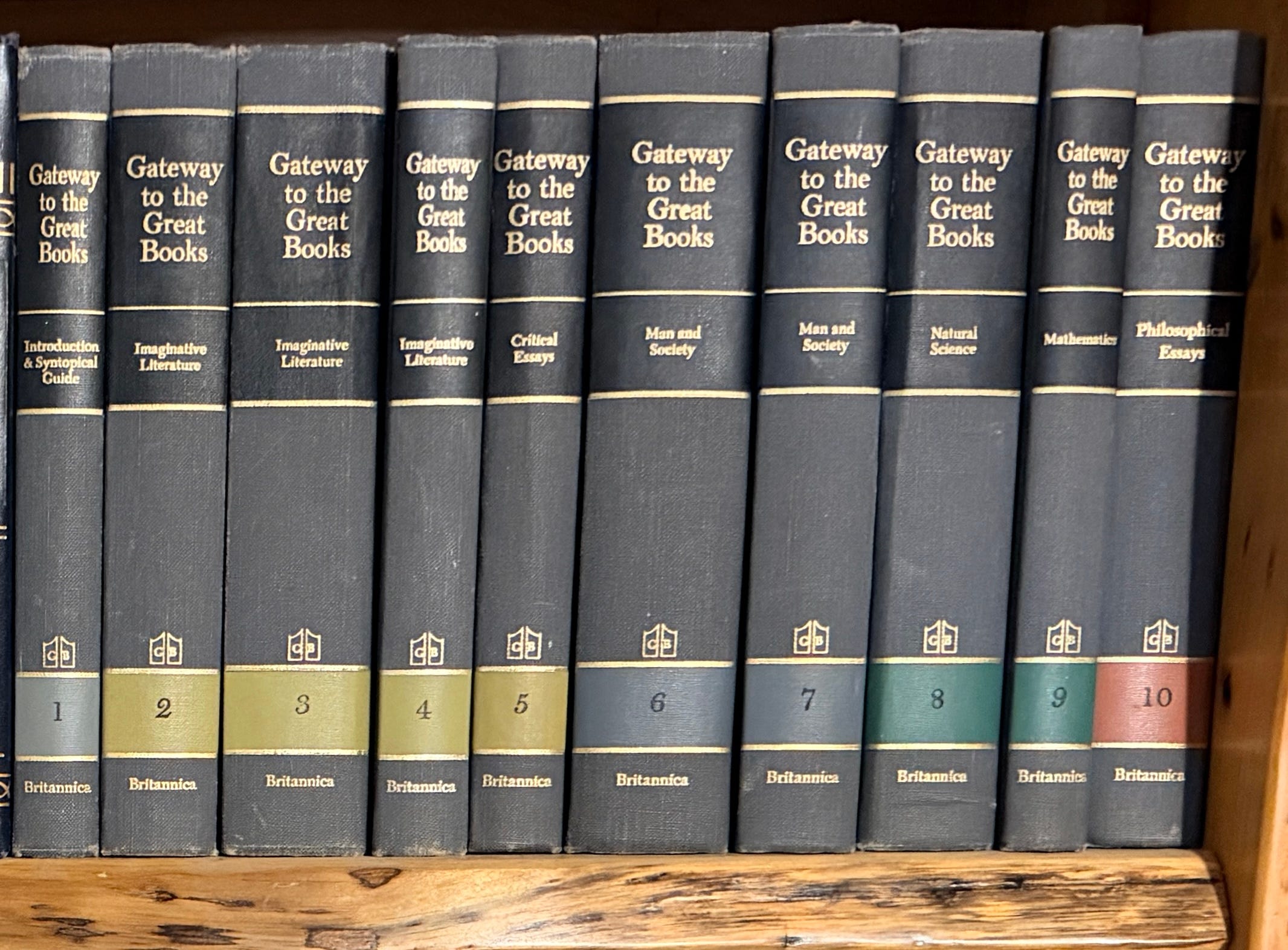
In 1963, Encyclopaedia Britannica published the Gateway to the Great Books, a set of ten volumes meant to encourage readers—even “seduce” them—into the habit of reading, “and in particular into the habit of reading [its larger] Great Books of the Western World.”1
Its editors, Robert M. Hutchins and Mortimer J. Adler—who were also responsible for The Great Books of the Western World series—compiled two hundred twenty-five shorter works written by more than a hundred and thirty authors into nine of those volumes. These consisted of stories and plays, critical and philosophical essays, speeches and state papers, letters, and some of the very papers in which scientists and mathematicians announced their discoveries. The first volume introduces the Gateway series and concludes with a reading plan for students ranging from 7th grade to sophomore in college. Most of the pieces are short enough that they could be read in a single sitting, but deep enough they would never be exhausted in a solitary reading.
Regrettably, sets of this kind still tend to become shelf aesthetics, handsome library furniture admired by guests, and only taken down when they need to be dusted. Even at the time of its publication, Hutchins acknowledged that “two objects consume our time: work and distraction.”2
And if work and distraction were making it impossible for the average person to keep his attention on something important for more than half an hour in 1963, how much more do we in the twenty-first century need to cultivate a meaningful use of our leisure time?
Your Official Guide to the Gateway
The Gateway to the Great Books set is still an excellent resource for fostering questions about “what it means to be human, what a human society is, and what is good for—or even interesting to—a human being and a human society.”3 Since a “gateway” exists to be entered and passed through, I have created a comprehensive guide to help readers make their way through these books, one month at a time.
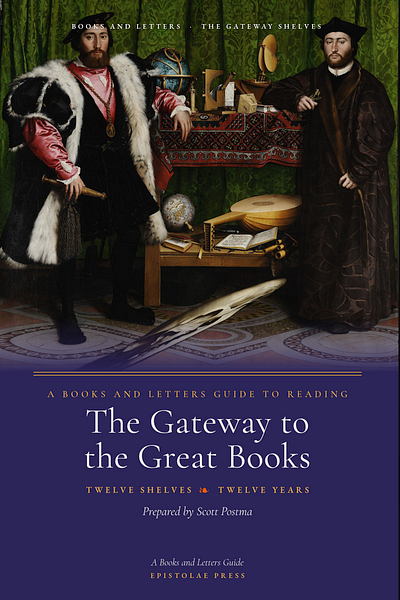
My plan is simple. I have made PDFs of the Gateway to the Great Books available for free at BOOKS AND LETTERS. Next, I’ve arranged the two hundred twenty-five selections into one hundred forty-four monthly readings gathered (digitally) onto twelve proverbial shelves, one shelf per year.
Every selection in the Gateway to the Great Books is presented once over the course of the plan. Each year a reader will encounter all six of the fields into which the editors divided the set: imaginative literature (volumes 2–4), critical essays (5), man and society (6–7), natural science (8), mathematics (9), and philosophical essays (10).
Compliments of BOOKS AND LETTERS in partnership with Epistolae Press, it’s yours, free.
Notice in the chart on p. 12, for example, January always opens with literary criticism, so that each year the reader begins by thinking about reading itself. Other months follow similar patterns (e.g., February is for literature, October is for mathematics, etc.)
Within each field, I’ve attempted to have readings broadly follow the editors’ graded plan, so that the early shelves keep mostly to its first two levels and the later shelves ascend toward its fourth level. Additionally, the reading pace is deliberately meant to be modest. Each shelf averages about thirty pages per month, which is basically a page or two per day, or an evening or two of reading for most readers. The lightest year runs to approximately 280 pages, and the heaviest year, by reason of Einstein and Infeld—and Dewey—to about 520 pages.
A twelve-year program of reading may seem like a long road, especially for our instant-gratification culture. But my plan is not meant to simply “get through the books”; it’s meant to keep company with readers’ rhythms of life. One might even think of this plan somewhat like the church calendar which returns to the same seasons every twelve months. In the case of the reading plan, the reading selections will do the same while advancing a little in depth and complexity each time round. Obviously, the seasoned reader who reads at a faster pace may want to finish sooner than twelve years. That’s fine too. The Gateway Book Shelf is meant to be a guide not a chain to bind your conscience.
Additionally, readers who subscribe to the BOOKS AND LETTERS Book Shelf may want to read the Gateway Shelf in tandem.4 Since both Book Shelves host shorter works or selections of longer works, they will easily compliment each other without overwhelming even a novice reader. As to your reading method, I’d like to offer three words of counsel, in light of Francis Bacon’s observation (who happens to appear in the first month of the first shelf alongside Woolf): “Reading maketh a full man; conference a ready man; and writing an exact man.”
First, I suggest reading each selection twice, once straight through (in a single sitting if possible) just for the pleasure of it, and once with a pencil in your hand (and perhaps a pipe in your teeth), annotating in the margins as you converse with the author as if he were in the room with you. Second, write—because good writing is clear thinking made visible. At the very least, write a sentence or two in a commonplace book so you can remember and review the wisdom you acquire through your reading. Third, talk about the reading with others: a spouse, a friend, or a reading group like The Society of BOOKS AND LETTERS. The great conversation is of little value when it’s merely a monologue.
The guide tracks with the 1963 edition and the level assigned in the editors’ graded plan, I being the most accessible and IV the most demanding. A small radio button has been placed beside each month for the reader who likes to check boxes, and there’s an index of authors near the end of the book in case it might be helpful to see at a glance who is represented in the volumes of the Gateway to the Great Books.
It’s been said that one becomes, in no small measure, the books one reads and the company one keeps. I trust this reading plan will assist you in keeping better company than you might otherwise keep if you were only left to your distractions.
lectio transit in mores (what we read passes into who we become).
SCOTT POSTMA
Fernwood, Idaho

Robert M. Hutchins, “A Letter to the Reader,” in Gateway to the Great Books, ed. Robert M. Hutchins and Mortimer J. Adler, vol. 1, Introduction, Syntopical Guide (Chicago: Encyclopædia Britannica, 1963), 1.
Hutchins, “A Letter to the Reader,” 2.
Hutchins, “A Letter to the Reader,” 3.
There are two different Book Shelves discussed here. The BOOKS AND LETTERS Book Shelf is free gift to subscribers and is the reading for our monthly Lectio. The Gateway Book Shelf is a stand alone guide for readers of the Gateway to the Great Books series.
Wonderful idea! I look forward to participating.