Writing from Yorkshire
with a final invitation to my Christian Humanist Reading Life course
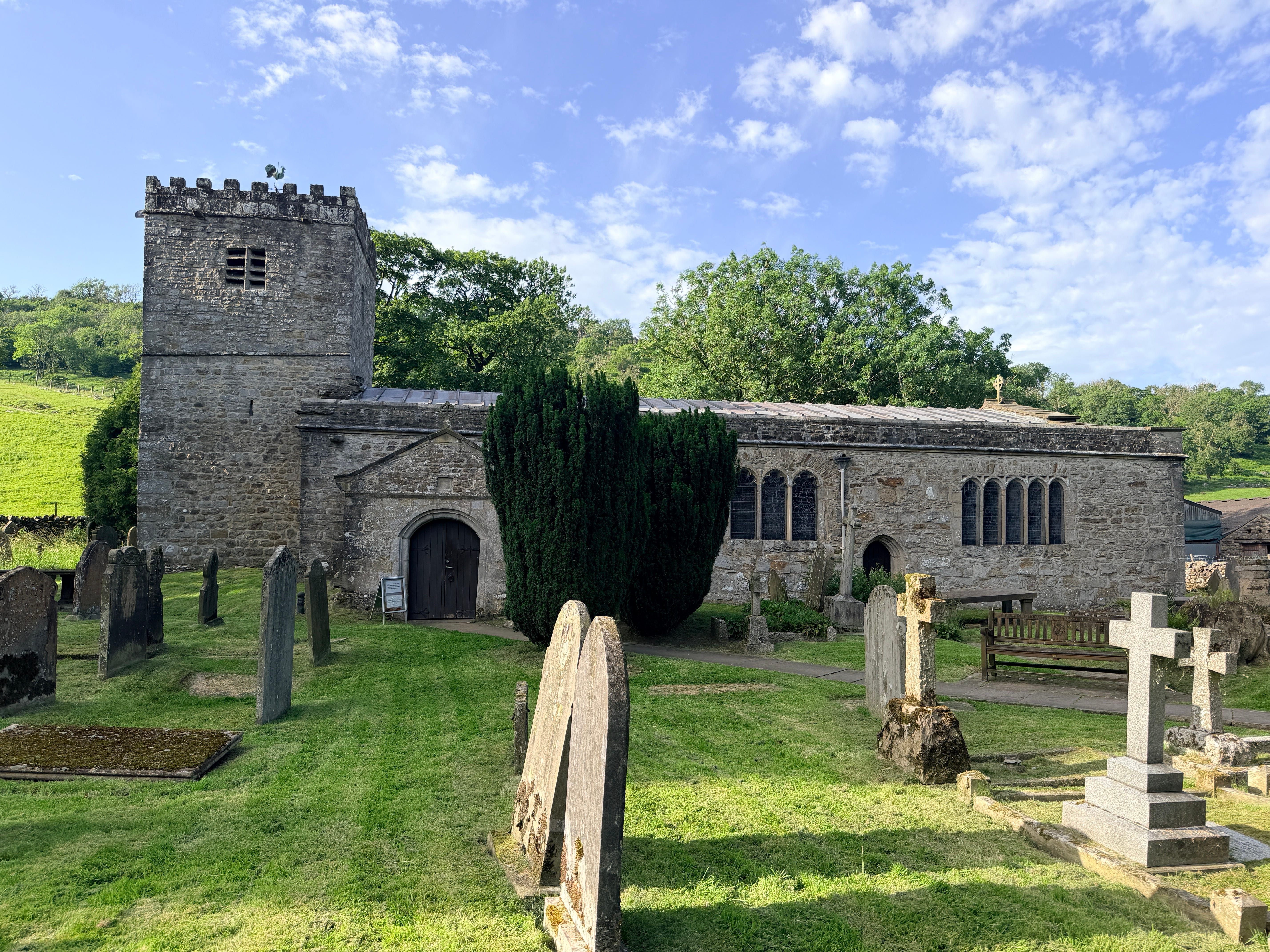
The church pictured here is St. Michaels & All Angels Church in Hubberholme, a more-than-800-year-old church that stands on the site of an even older Anglo-Norse burial ground. It originally served as a Norman forest chapel for Langstrothdale Chase.
I am writing this post from the tail end of a twenty-nine-day journey through Europe with my wife and daughter. One of our final stops before flying home early next week is a visit to the Yorkshire Dales.
If you have ever watched the modern adaptation of James Herriot’s All Creatures Great and Small, you have seen this countryside. It’s made up of rolling green hills stitched together by ancient dry-stone walls and littered with sheep and cows. There are romantic narrow lanes threading between villages of warm limestone, arched stone bridges spanning clear streams and rivers, and historic churches still in use that date back to the era of William the Conqueror.
It’s the kind of landscape that reminds the modern man that there are things older and truer than the cultural and political noise of the present moment.
Yesterday, we walked cobblestone streets and 13th-century city walls, inspected ruins built by the romans in AD 71, visited citadels and castles built by King Edward II, and ate our dinner in an village pub. We even took a moment for my wife to make friends with a stranger’s Sheltie outside a stone cottage that not only served as the exterior of Siegfried Farnon’s vet clinic called the Skeldale House but has probably been standing since before the American founding.
Yorkshire was, in a word, magical. It was the kind of place that makes you want to read good books, take long walks, think deep thoughts, and live life much more slowly.
This brings me to one final word about my Christian Humanist Reading Life course, a 6-Week Live Course for Adults that begins July 7th.
The Yorkshire Dales are beautiful precisely because they have resisted the modern impulse to flatten, accelerate, and optimize everything. The hills are still hills. The stone walls were laid by hand centuries ago and have not been improved upon. The villages still have a center, comprised of a church and a pub, where people actually still know one another.
That is, in miniature, what this course is all about: recovering a center. As I stated previously, we live in an age of unprecedented access to information and unprecedented poverty of wisdom. This course is a six-week guided recovery of attention, the love of learning, the Great Conversation that has shaped Western civilization, and of a way of life capable of sustaining genuine intellectual and spiritual formation.
The Course Outline: Six Weeks; Six Sessions
Week 1 — What Is a Human Being For?
Everything begins with anthropology. We recover the doctrine of imago Dei and ask what it demands of how we live, learn, and love.
Week 2 — Live Not by Lies: Truth, Attention, and the Life of the Mind
Before we can think well, we must be capable of sustained attention — and that is precisely what the age of noise has stolen from us.
Week 3 — Ordering the Loves: The Good, the Good Life, and Augustine’s Ordo Amoris
Augustine knew the deepest human problem is not ignorance but disordered desire. The examined life is, at its root, a project of rightly ordered affections.
Week 4 — Words Create Worlds: Language, Beauty, and the Liberating Arts
Words are not neutral instruments. They participate in the logos structure of reality. We recover the classical arts of grammar, logic, and rhetoric as disciplines of formation, not technique.
Week 5 — Into the Great Conversation: Reading, the Canon, and the Moral Imagination
Through Lewis, Tolkien, O’Connor, and Dante, we explore what it means to read well and why the moral imagination must be cultivated rather than merely assumed.
Week 6 — A Rule of Life for the Christian Humanist
The course closes with a personal commission. You will leave with a concrete rule of life — rhythms and practices suited to your vocation and season — that make wisdom not an aspiration but a daily reality.
The Details
Six live Tuesday evening sessions beginning July 7th. Ninety minutes each. A small cohort of no more than thirteen students intimate enough for genuine conversation, small enough for every voice to matter. Your enrollment includes a copy of my book Becoming Classically Educated, which serves as the backbone of the course. The investment is $397.
The Door Closes July 1st at Midnight. Fewer than a handful of seats remain.
Standing in the Yorkshire Dales this week, I was reminded that the things most worth having—wisdom, friendship, beauty, a well-ordered life—are not acquired in haste and they certainly cannot be downloaded. They are cultivated slowly, in community, over time, with the right guides and the right companions.
That is what I am inviting you into.
If you have been on the fence, let me encourage you with this: the conditions will never be perfect, and wisdom does not wait for a convenient moment. The tradition we will study together is, among other things, a long argument that the examined life is not a luxury for the leisured but a real calling for the faithful.
I would be honored to have you in the room.


