
When The Destination is No Longer the Journey
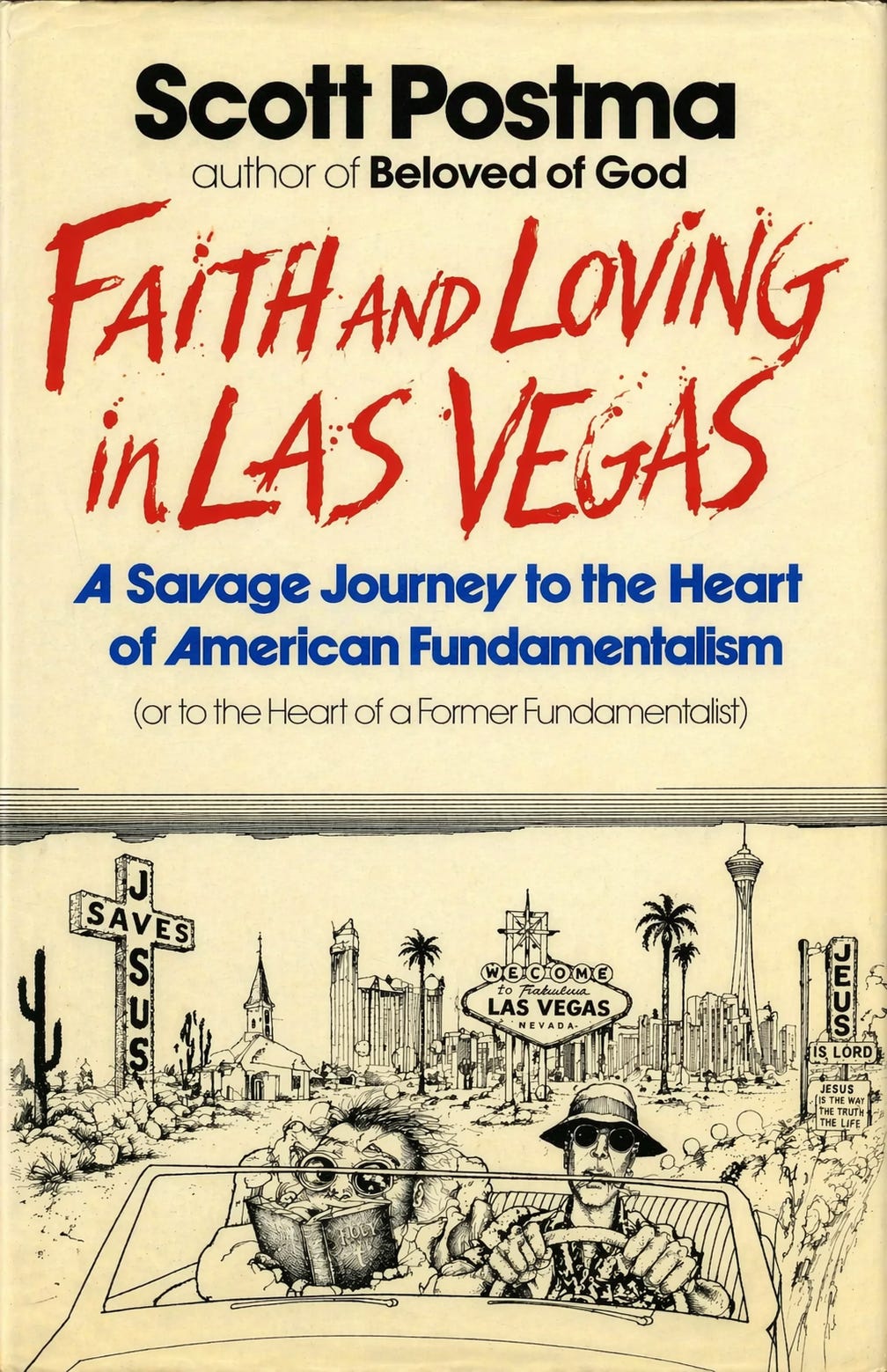
Faith and Loving in Las Vegas: A Savage Journey to the Heart of American Fundamentalism
Most trips begin with a destination in mind, unless you’re taking one of the road trips my military buddies and I used to take on a weekend pass. We would just hop in a car of someone willing to drive and head out on the highway looking for adventure—or whatever might come our way. Happy to see where the wind would blow us for the next forty-eight hours, we didn’t have a plan or a particular direction; our only agenda was fun and adventure.
When I took road trips with my family growing up, it was a lot different. My dad had a map, a budget, and for a while, a motorhome. We usually set out for a lake, some mountains, or sometimes grandma’s house. But we always had a destination and a deadline. My dad didn’t stop much when we traveled places. I got the sense stopping was taboo. I’m pretty sure that’s why we had the old wander wagon.
In the motorhome you had food and drinks and a bathroom, everything one needed to always make “good time.” I remember looking out the back window of the roaming rover gawking at all the other travelers wondering what it would be like to stay in a motel or stop at rest stops like they did. I would gaze at the scenery as it blurred by, watching for cool places I wanted to come back and explore and think that it must be a big thing to make good time.
Truthfully, my dad never said much about it, except when we were failing to make good time. Mostly, he would just look at his watch when we reached our destination, and report, “We made good time.”
There was this one time my dad stopped, though, near Bryce Canyon in Utah. I remember looking out the window trying to make the cars behind us levitate with my mind (It’s complicated and irrelevant to this story, but that’s what I was doing when I was nine or ten), when suddenly I heard a commotion behind me.
We had all been drinking Orange Crush and putting our cans in the cup holders that were mounted on top of what they called “the dog house.” I’m not sure why, but that’s the name they give the engine compartment cover between the front seats, a feature distinctive to motorhomes, buses, and some older vans. On the top of the dog house was a half-dozen-or-so cup-holder slots. My younger brother, who was about five or six at the time, was thirsty and started picking up the cans and shaking them to hear if any of them sloshed inside.
On the fourth or fifth can, he heard what he was looking for, threw his head back, mouth wide open, anticipating some refreshing orange soda. It was only about two swallows before he, and everyone else, realized he had located my dad’s spittoon.
A slimy, tar-colored mixture projected through to cab—along with the rest of his stomach contents! My dad stopped that time. It was the fastest I’d ever seen him pull over our transit tank. We also didn’t make very good time that trip, but the scenery at Bryce Canyon was great.
Somewhere in my formative years, I learned to approach much of life the way I remember my dad approaching road trips—with a destination and a deadline. Of course, making good time works well enough when you need to get from point A to point B in a hurry, but it’s a much less adequate way to live life and do ministry.
Academically, I knew all the clichéd maxims: the journey is the destination; happiness is a way of traveling, not a place to arrive; the process is our product and presence is the ultimate prize. My heart got it but my head harbored the constant objective of “just finishing.”
Unsurprisingly, the fundamentalist version of Christianity I inherited and adopted shared the same instinct. Heaven was the destination, the “Roman’s road” was the map, the “sinner’s prayer” was the ticket to get there, and everything else—the perennial human questions, the pursuit of beauty and goodness, meaningful conversations, even family fun and sharing in our children’s stories—were all delays to making good time. Sanctification was all about spiritual efficiency; and growth, not God, was the goal.


