


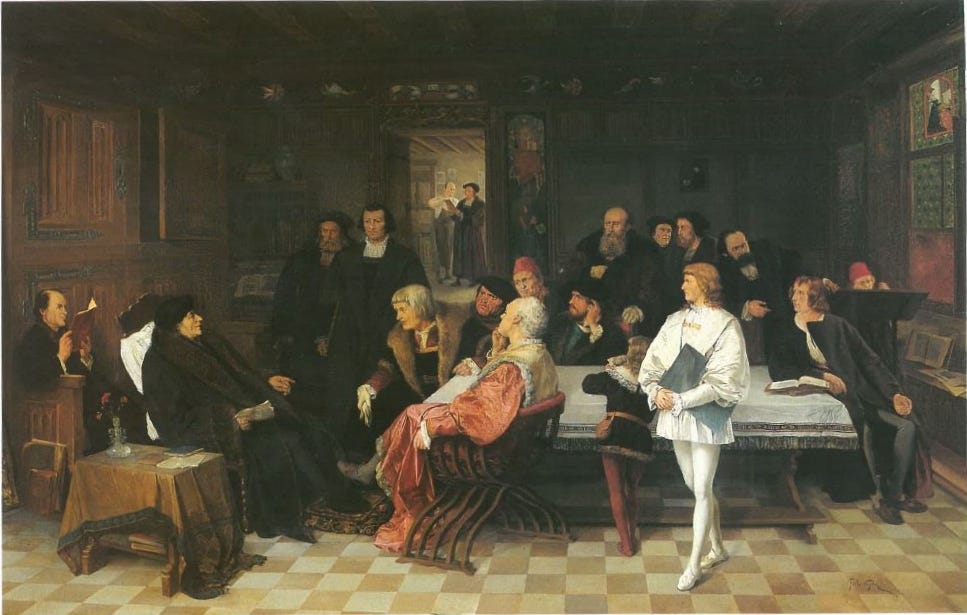
Desiderius Erasmus (1466 – 1536) championed the renewal of the classical studia humanitatis in concert with Christian theology. His manifesto for this Christian humanism was laid out in a work called, The Antibarbarians, a Platonic-styled dialogue among friends gathered in dutch garden at a country estate to discuss literature, theology, and the Republic of Letters.
Because the humanists of the fourteenth and fifteenth centuries were met with significant opposition by Church theologians and educators long-steeped in the medieval scholastic pedagogy, he deemed it necessary to map out the circumstances of their conflict via the speeches of the chief interlocutor of his dialogue, Jacob Batt.
Through Batt’s monologue, Erasmus identified three enemies of Christian humanism: the destroyers, the reductionists, and the tyrants. I explore Batt’s monologue and give a brief overview of the enemies of humanism in this post. In additional posts, I treated the destroyers and the reductionists (Batt calls them limiters). In this post, I’ll address Erasmus’s third enemy of the Republic of Letters, the tyrants.
The Tyrants
This third enemy of the Republic of Letters is the people Batt says we should fear the most: “people who admire and approve of every kind of literature, especially poetry and rhetoric, but on condition that they themselves are considered the finest poets and orators” (emphasis mine). Batt further explains:
The last group might perhaps be judged not very bitter enemies, because their offence comes from zeal, not hatred; but I find them far and away the most harmful. The others attack under hostile banners and can be driven from the ramparts, but these are living inside the walls, in our very strongholds, and by their weapons and badges look like our friends, but all the time they are planning for the eternal ruin of the republic under a deceptive appearance of devotion, and the more they strive to deliver their country, the more they entangle it in shameful slavery… One among them writes on grammar, another on rhetoric, another on dialectic, another on natural philosophy, another on theology; while this one writes commentaries on the best authors, shedding darkness on them, not light.
The tyrants don’t burn books, they just muddle the entire enterprise of education by making everything about themselves and their own prestige. In Erasmus’s day, these are the poets and writers who, being the least capable at their crafts, were the most zealous about getting attention and instituting their private curricula.
In the modern context, they are akin to internet influencers who are good at capturing views and clicks, but haven’t developed anything of eternal value to pass on to those who desire to flourish. Instead the modern tyrants dominate the marketplace with ads selling a $47 PDF of their latest get-rich-quick scheme.
In an institutional context, the tyrants are most like the modern universities who have made an art out of leveraging market data and government money to capture the minds and souls of unwitting students who believe they’re paying for a genuine college education. Instead, they’re sold utilitarian market skills, loaded with debt, and sent off to their servile careers with a culturally-approved sheepskin to hang on their wall.
However they garner attention, the tyrants ultimately rule by controlling words. They bury the truth in the slop of segregated subjects, propaganda, and ideological ambition. Thus, when ideas are segregated into subjects, each distinct from the other, reality can only be conceptualized in fragments. This is especially ominous in a culture dominated by technical jargon, ideological euphemisms, and bureaucratic talking points. Here words often obscure rather than reveal truth. For the tyrants, language doesn’t serve human flourishing; it serves to manage human perception.
The political logic of the tyrants wasn’t lost on Erasmus. Batt asserts, “Petty tyrants want the people to be stupid, the more easily to impose what they want and get anything accepted, and to frighten people through superstition; for superstition is a thing from which erudition usually sets one free.” The influence of this cultural crime is remarkably familiar.
Consider the cognitive dissonance of parents who recognize the ploy of higher education but still feel compelled to send their children to college. And how uncanny is it that modern society is almost exclusively conceptualized in specialized fragments? The dissonance and fragmentation drives much of the modern culture wars, grossly impeding our ability to have rational public discourse.
This brings me to the most uncomfortable point in Batt’s analysis. The tyrants live “inside the walls, in our very strongholds.” They attend our conferences, wear our badges, speak our language. They may even be us. Which is why negotiating the extremely difficult challenge of recovering Christian Humanism within a secularized culture polarized by “isms” (Islamism, communism, and evangelicalism) is going to require wisdom.
It’s going to require the wisdom to recognize the ultimate manifestation of gospel dominion (Matthew 28:18–20) is the work of the Holy Spirit, not the work of Christian actors employing Machiavellian or Nietzschean tactics in the political arenas.
It’s going to require the wisdom to not formulate Christian Humanism into its own ideological movement that sets itself up in opposition to existing ideologies all competing for the top position in the political and cultural dog pile.
It’s going to require the wisdom to not silo into our own little Christian Republics who are not only at war with secularism but also at war with others inside the Christian intellectual tradition who don’t dot their i’s or cross their t’s in the same manner we do.
Erasmus himself, I think, would warn us against the temptation to hold up Christ’s lordship as merely an intellectual axiom. God forbid! His own philosophia Christi was that of simple piety and not any kind of ideological system—i.e., the best of Christianity is a life worthy of Christ.
Christian Humanism is not sectarian, nor does it hold a vision of Christian dominionism that is spiritually or politically coercive. It is a gracious and irenic tradition that seeks not only to discover what it means to be fully human with the resources of the Christian faith, but also simultaneously seeks the peace and welfare of the city of man with an eye toward the common good of all. This means that although kindness cannot supplant truth and consensus cannot be cherished over compromise, when controversies do arise—and they will—we should alway speak the truth, and do so in love.
Tellingly, Batt never fights this third battle, that with the tyrants. “But, leaving them aside,” he says, “(for to discuss the subject one would have to go on for ever), I shall fall on the other two lines.” Then, just as Batt’s friends urge him on, the burgomaster’s servant arrives to say that dinner is spoiling, and the burgomaster adjourns the debate: “The rest of the discussion we can finish this afternoon sitting together in my garden.”
Because only this first of Erasmus’s four projected books survives, that day never came. The translator of The Antibarbarians adds a wistful note: “That afternoon, for us, has not arrived.” I would like to suggest that Batt’s afternoon session belongs to us.
Batt told us that every century is allotted its own gifts. If the pagan centuries were the sap and the bud, and Christ’s century the ripe fruit, ours may be the season that “passes from autumn into winter,” the season Batt says “is spent in making new shoots for the coming summer.” And he adds, “Even winter itself is not idle, but reestablishes things in an interval of quiet.” Thus, this era belongs to us.
In this postmodern era, thinkers like Richard Dawkins want their cathedrals, but without the creeds. They want the resonance of the hymns, but without the Incarnation. I would argue the future of Western culture cannot be secured by aesthetic sentimentality and it can’t be recovered by a civilizational inertia which outran its original Christian vitality. It must be rooted anew in the transcendent—in the true, the good, and the beautiful as revealed in the Incarnation of Christ.
The recovery of Christian humanism is not an attempt to retreat into the past. It’s not even the noble work of Christian evangelization, per se. It is the replanting of perennial wisdom in post-Christian soil. It is an invitation to consider the Logos beneath the liturgy, the Word behind the wisdom, the incarnate Truth that dignifies all learning and labor. It’s an invitation to cultivate a world where education forms the whole person, where the cultural conversation fosters meaning and reverence for the permanent things, and where flourishing is measured not by self-assertion but by love of God and neighbor.
Christian humanists believe everything that is good, true, and beautiful belongs to and comes from God. Even the good works of Pagan and pre-Christian cultures were inspired by the Holy Spirit for his own purposes. It’s up to Christians to harvest the pollen from their flowers and make good honey. Such is the high calling of Christian Humanism. My hope is you will join me in becoming the planters and gardeners of such a future.