
The Lifecycle of the Classical Christian School - Part 1
A Platonic Meditation on Leadership, Mission, and Renewal

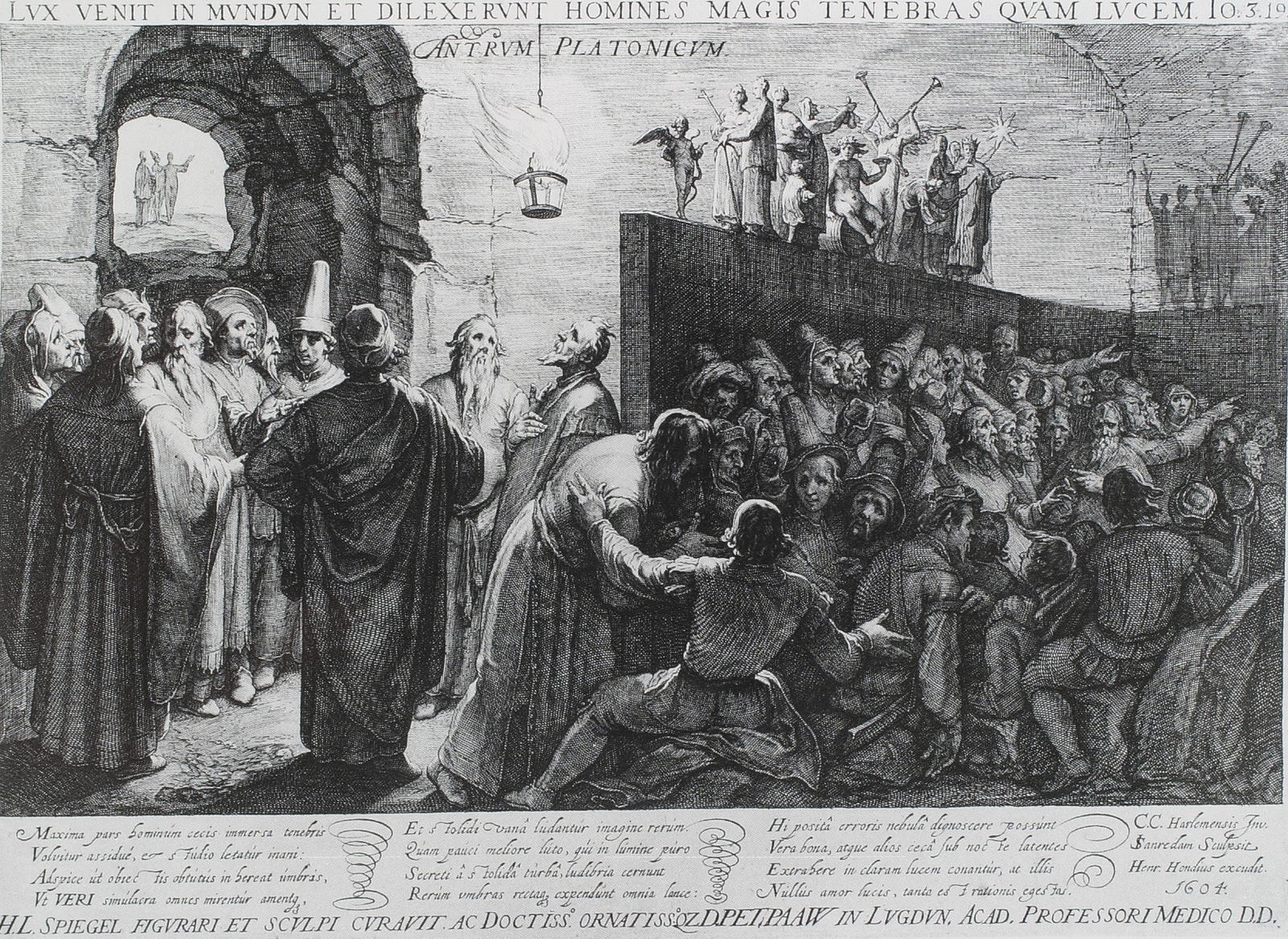
The Allegory of the Cave
In Book VII of Plato’s Republic, the Allegory of the Cave offers one of the most profound meditations on education and leadership in the Western tradition. Every philosopher, educator, and Great Books student knows about The Cave. It’s one of the staples of a liberal education. Yet, many never actually lean on it or proactively put its principles into practice.
Too often, it sits in the classical educator’s mind like a marble bust on a library shelf where everyone unconsciously recognizes the aesthetic value it adds to the library; yet, few pay attention to its likeness or pause long enough to meditate on the life of the person it represents.
Let’s recall the allegory: A group of prisoners are chained in a cave, staring at shadows on the wall, mistaking illusions for reality. One prisoner is freed, ascends into the light of the sun, and after a painful adjustment comes to know the true forms. The former prisoner then returns to the cave, not to lord his knowledge over the others, but to lead them into the light.
The allegory captures the essence of the classical educator’s calling. But here is what a lot of people miss. Plato’s allegory is more than a model of intellectual ascent; it’s also a model of moral virtue and personal responsibility. Education, as Plato understood it, is the liberation of the soul from ignorance and vice so it can behold the truth and function in virtue.
Plato insists that we think, not just with our minds, but with our whole soul which must be rightly ordered: noetic, thymotic, epithymatic. The predecessor to C. S. Lewis’s head-chest-belly sentiment, the head must rule the belly through the chest. Consider Plato’s dialogue with Glaucon:1
But then, if I am right, certain professors of education must be wrong when they say that they can put a knowledge into the soul which was not there before, like sight into blind eyes.
They undoubtedly say this, he replied.
Whereas, our argument shows that the power and capacity of learning exists in the soul already; and that just as the eye was unable to turn from darkness to light without the whole body, so too the instrument of knowledge can only by the movement of the whole soul be turned from the world of becoming into that of being, and learn by degrees to endure the sight of being, and of the brightest and best of being, or in other words, of the good.
Very true.
If Plato is correct about nature and capacity of education, then to emerge from the cave will require a great injustice (517, 519d). It means a perilous journey back into the cave, one that involves disorientation, resistance, and suffering. Plato calls it an injustice because the philosopher must either become unjust himself by not descending and sharing the knowledge of the truth when he is compelled; or he must suffer an injustice by descending and being disoriented, resisted, and abused.
Perceptual Expertise
I propose that the Allegory of the Cave can also serve as a fitting metaphor for understanding the lifecycle of a classical Christian school. Just as a soul matures through stages of ignorance, illumination, and injustice (i.e., either by transformation or by decline), so too a school passes through similar phases of birth, management, and suffering—either by decline or by renewal.
At each phase, the health of the school depends on much more than systems or strategies; it depends on the moral vision and perceptual clarity of its leaders. For this reason, school leadership must cultivate what I will call perceptual expertise: the ability to perceive the truth of the institution in all its complexity, and to act wisely and humbly in light of that perception.
In Part 2, I will walk through the three stages of the school’s lifecycle; but first, I want to explain my use of this expression, perceptual expertise. I am actually repurposing the expression here having borrowed it from Matthew Crawford in his book, Shop Class as Soulcraft, where he maintains forensic perceptual expertise is the mark of an expert mechanic.
To illustrate, the expert mechanic—the one who has cultivated forensic perceptual expertise—is the guy in the shop that knows what’s wrong with the car just by hearing it run or hearing the story of how it broke down. The novice can also diagnose is but he is going to need to get out his equipment and run through his checklist. While he’s not a bad mechanic, per se; he’s certainly not an expert. Similarly, as a novice, he is not the expert’s opposite either.
The expert’s opposite is an idiot (to use the word in its original meaning). The Greek work idios means “private,” and idiōtēs means “private person.” An idiot in this context is literally one who does not grasp his public role: his role entails perception and active concern for the other (person or thing).
An idiot is one who is not intellectually or morally involved. He is not concerned where his public role requires it. He may never say it out loud but he has the disposition and moral torpor of one who believes, “It’s not my monkey, not my circus,” when his role actually requires it.
We also take our English words “idiomatic” and “idiosyncratic” from this same Greek word, both of which suggest self-enclosure. The idiot is closed off, doesn’t listen, and jumps to conclusions because of his premature conceit of knowledge. An idiot is not unintelligent, necessarily; he’s foolish. His is not so much an intellectual failure as his is a moral failure. Sticking with the mechanic scenario, the idiot is the guy that carelessly and in haste, grabs the wrong wrench for the bolt and strips it out, or starts beating on things with a hammer when the job requires some actual finesse and thoughtfulness.
Crawford himself borrowed the insight of the idiot from Robert Pirsig’s book Zen and the Art of Motorcycle Maintenance. Pirsig tells the story of a mechanic shop that had butchered his bike after numerous times of taking it back to them. He writes,
Why did they butcher it so?.. They sat down to do a job and they performed it like chimpanzees. Nothing personal in it... But the biggest clue seemed to be their expressions. They were hard to explain. Good-natured, friendly, easygoing—and uninvolved. They were like spectators. You had the feeling they had just wandered in there themselves and somebody had handed them a wrench. There was no identification with the job. No saying, “I am a mechanic.”
There is a bit of a paradox going on here. The more personally one owns their work, the less private and more universally thoughtful they are about the work. The opposite is also true. The less attentive or less ownership one takes in his work, the more private, or closed off, he is in his thoughts about the work. To not take personal ownership of the work is to remain a spectator, and spectators are solipsistic and idiosyncratic. Perceptual truth, that truth which is universal and applies to all of us, does not reveal itself to spectators.
This means having a degree, a license, or a credential does not mean a person is an expert, or that the truth as it relates to that person’s work will automatically reveal itself to him or her. Having a title or degree doesn’t mean the person will perceive what it’s going to take to get to the truth of the matter. Unfortunately, we see this all the time in academia (and often in the church too). Think of the headmaster (or the pastor) who is building his own resume rather than the students, the people, or the institution that he’s been entrusted with.
The idiot lacks the attentive openness that seeks things out in a shared world; in a word, he isn’t concerned with universal truth. The universal truth here can be understood as the issue needing to be addressed or the thing that is broken. And it is so in the particular way that’s the same for everyone. To address it or fix it is going to require moral responsibility—a turning of the soul toward the sun—to get at the truth of it. You can’t just wing it. You can’t fake it till you make it.
For example, one cannot be an expert headmaster and simultaneously a headmaster who is concerned first with his own needs, his own advancement, his own “whatever” more than the public work he’s (or she) is called to. THIS IS THE GREAT INJUSTICE! Perceptual expertise is only conceived in those who willingly go back down into the cave regardless of the cost.
And, this brings us full circle, back to Plato’s (and the Christian’s) understanding of truth and light. One must be good (in a particular way; this way I’ve just described) to know the truth. Truth and goodness are transcendentals and therefore share one ultimate end. They both (along with beauty and unity) converge in God himself.
Thus, intellectual virtue cannot be separated from moral virtue. To be good at anything that requires sound thinking—to be an expert, say, at school leadership, or anything else—one must take personal ownership of his or her commitment to universal truth. This is the virtue of perceptual expertise.
Plato, The Republic, BK VII. 528c-d.


