

The Intellectual Life by A. D. Sertillanges
A Very Short Book Review

Sertillanges, A. D., and Mary Ryan. The Intellectual Life: Its Spirit, Conditions, Methods. Westminster, MD: The Newman Press, 1962. ≈ $20
I started reading The Intellectual Life: Its Spirit, Conditions, Methods in the fall of 2016. Born Antonin-Gilbert Sertillanges (16 November 1863 – 26 July 1948), the author, a French Dominican priest who took the name Antonin-Dalmace Sertillanges when he entered the Dominican Order, first published the work in French in in 1921.
It was translated into English by Mary Ryan, and because of the author’s name change, it’s possible to find copies of his books identifying him as A. G. Sertillanges and copies identifying him as A. D. Sertillanges. My copy presents his name as the latter.
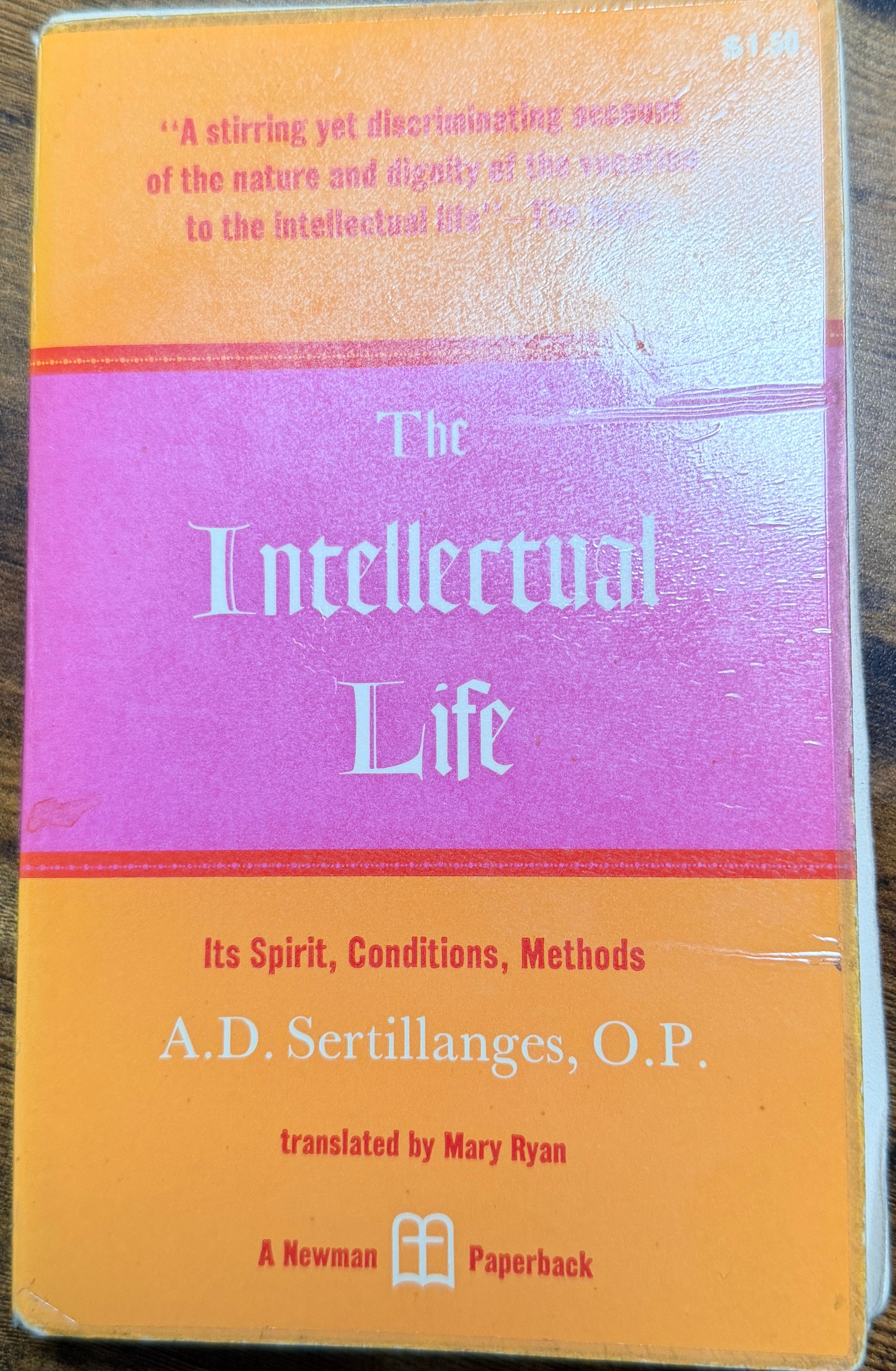
I said that I “started reading” the work because for nearly a decade now, I haven’t technically stopped reading it. Like most of my book hauls (when I can find them), I purchased this copy used, but in excellent shape. Save for some writing in the flyleaf and a few colored pencil annotations, it was “like new,” in every other respect when I got hold of it—solid binding and no damage to cover or pages. As it sits today, the binding is falling apart, the cover is falling off, and the pages are filled with numerous pencil marks and annotations. There’s no telling how many times I’ve been over its pages and it shows.


There are a few books in my library that I revisit often but this one is beloved because of the manner in which Sertillanges dignifies the life of the mind and honors the intellectual vocation of writing. I suppose I’ll never tire of being reminded that for the one who is called to the vocation of making good thinking visible, this labor is too consequential not to do it well.
Similar to the way the Holy Writ teaches us the fear of the Lord is the beginning of wisdom, Sertillanges instructs his reader that in the intellectual world, the beginning of wisdom is ensuring one’s attention is freed from every inferior preoccupation that might draw him away from his sacred calling to participate in the truth conveyed to him by the universe (ix). Yet, simultaneously, the intellectual worker must “refuse to be a brain detached from its body, and human being who has cut out his soul” because he has made “a monomania of the work” (241).
At the heart of this little book is the message that the Intellectual worker has a sacred calling and that sacred calling requires a “response which, in one effort to surmount self, hears and consents”(xi). Likewise, the call is not without its means or its results. These too require the same virtue as the response to the call—selflessness, obedience, and good judgment; that is,
settling one’s way of living, one’s society, the organization of one’s time, the place to be given to contemplation and to action, to general culture and to one’s specialty, to work and to recreation, to necessary concessions and to stern refusals, to the concentration that strengthens the mind and the broader studies that enrich it, to aloofness and to contacts: contacts with men of genius, with one’s own group, with nature, or with others in general social life, and so forth. These things also can only be wisely judged of in the moment of ecstasy, when we are close to the eternally true, far from the covetous and passionate self. And when we have done our part, results and the measure of them will demand the same virtue of acceptance, the same selflessness, the same peace in a Will that is not ours. (xi)
Even if every aspect of Sertillanges’ instructions for intellectual workers doesn’t resonate, his broader message of thinking wisely and properly about the intellectual life—especially in our day of “influencers” and “content creators”—is quite possibly more relevant today than it was in 1921.