


In a previous post, I argued that recovering Christian Humanism in this post-modern era will require faith, courage, and wisdom. Which is to say, there’s an ongoing battle for the Republic of Letters, just like there was in Erasmus’s day. In his manifesto, The Antibarbarians, he maps out the battlefield through a monologue given by his chief interlocutor, Jacob Batt:
We shall therefore plead the cause of the old learning against its new opponents, and I see that the trouble comes mainly from three types of enemy. There are those who want the Republic of Letters to be destroyed root and branch. Others are doing their best to get its power not exactly extinguished, but restricted within narrower limits. Lastly there are those who want to see the republic preserved but utterly ruined, by themselves becoming tyrants, abrogating the laws of our fathers, and introducing foreign magistrates and behaviour.
For Erasmus, there are three enemies of Christian Humanism. They are the destroyers, the reductionists, and the tyrants:
The destroyers want to eliminate the Christian Humanism root and branch. In Erasmus’s day, these folks saw the humanities as antithetical to the Scholastic’s logic-based education and—due to its use of profane texts (secular in modern terms)—poisonous to the Christian faith.
The reductionists (he calls them limiters) don’t feel the need to eliminate them altogether, but do want to limit and subordinate bonae litterae to their own “superior” curricula and pedagogy. The study of “good letters” can come after, if at all.
The tyrants refer to the mendicant orders of Erasmus’s day. He called them “beggars who rule,” uneducated men who sought to be in charge of schools for their own ambitious ends—petty tyrants. These are pretenders who advocate for humanism but only for their own ends and not the ends of good letters and human flourishing.
The Destroyers
In this post, I’ll address the first enemy Batt names, those who want the Republic “destroyed root and branch.”
The destroyers possess nothing in the way of real weapons or knowledge of warfare. Yet, they are most dangerous because they are “a savage horde massed together from the fields and hills.” They are “uncouth people who detest the whole of literature (which they call poetry) on some vague religious pretext.” Further, they “don’t march into battle,” says Batt. Instead, “they throw themselves into it like ravening wild beasts, mistaking fury for fortitude.”
This enemy’s “four strong points” are “fury . . . , noise . . . , numbers . . . , and lastly a kind of shield which is the pretence of religion.”

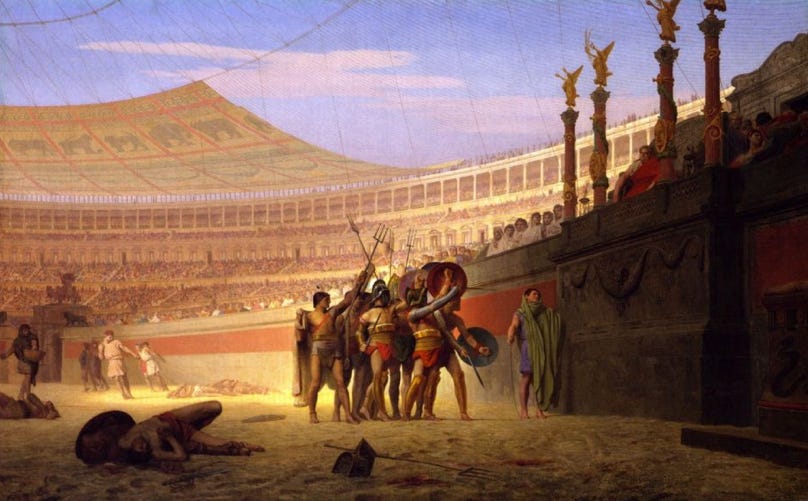
Batt likens their fury to the Andabatae, the Roman gladiators who fought wearing helmets without eye-slits. Cicero, in a letter to a friend, uses the image in a joking manner to describe blind, flailing combat.
He likens their noise to Stentor, the “bronze-voiced… who could cry out in as great a voice of fifty other men” (Homer’s Iliad, 5.785-86). Since Hera (the wife of Zeus) borrows Stentor’s voice to shame the Argives into fighting harder, Erasmus may have in mind not only the volume of his enemy’s clamour, but also the fact they cry out with a counterfeit authority.
Next, he likens their number to one that exceeds Xerxes’s 1.7 million man infantry (Herodotus’s Histories, 7.60). Erasmus seems to be using the hyperbolic image as a way of pointing out the perennial idea that a mob’s strength is in its sheer numbers, never its intellectual acumen.
Lastly, they possess a shield—religious pretense—and, it’s under this defensive instrument that they most often shelter. Since they are outside the world of literature, the sluggish, envious, prideful mob asserts an offensive in a manner that is blind and flailing, loud and hyperbolic; then they immediately retreat under the attractively-named shield of “simplicity and religion.”
The destroyers are still with us. Consider that in one camp, the Christian camp, Christian Humanism is often unpopular with who have yet to answer Tertullian’s notorious inquiry, “What does Athens have to do with Jerusalem?” These, believing they would be committing the sin of loving the world (1 John 2:15), stumble at the idea of reading pagan literature and plundering it for the splintered light of God’s wisdom. In their stumbling, they often find themselves caught up in the mob of the destroyers.
As an aside, it’s unfortunate Tertullian is so often quoted as being the enemy of secular literature and learning when in his De Idolatria, he notes:
We know it may be said, “If teaching literature is not lawful to God’s servants, neither will learning be likewise;” and, “How could one be trained unto ordinary human intelligence, or unto any sense or action whatever, since literature is the means of training for all life? How do we repudiate secular studies, without which divine studies cannot be pursued?” Let us see, then, the necessity of literary erudition; let us reflect that partly it cannot be admitted, partly cannot be avoided (Tertullian, De Idolatria, Book X).
Although he had his rightful concerns about the influence of Paganism on the Church, Tertullian wasn’t so much of a curmudgeon that he didn’t recognize the paradox of becoming literate in a world that was fundamentally Pagan in its infrastructure. After all, Tertullian himself was a learned man of letters.
Of course, in this observation, I have admittedly digressed.
Notwithstanding, where Batt’s barbarians carried one shield, I would suggest the enemy of our day carries two. Christian Humanism is also unpopular with secularists who despise everything “Christian” and see the modifier as an attempt to create a Christian subculture of humanism, a concept the secularists claim to have formulated themselves. But their shield, too, is a pretense of religion; because secularism is not a neutral arena; it’s a civil religion with its own dogmas and exclusions.1
It is also of great interest that Erasmus’s analysis of the enemies of The Republic of Letters in his day maps near perfectly with our own digital public square (i.e., social media and the internet).
Consider the modern Andabatae. They are quick to make their judgment about ideas, books, articles, and authors completely unread; they launch their attacks from reading a mere headline, listening to a soundbite, watching a TikTok video, or encountering the screenshot of a single quote on X or Instagram. It would be too much to ask these blind keyboard gladiators to take the time to read, investigate, and ask questions. Blind fury is their weapon of choice.
Consider also just how loud the digital noise is today. It’s not the voice of fifty, but the voices of fifty million with which The Republic of Letters must contend. In fact, the digital noise of social media cultivates the very antithesis of the sustained attention on which rational public discourse and the entire Republic of Letters depends.
And what more needs to be said about the metrics and algorithms that have become the modern arbiter of an idea’s value or merit. Subscribers, followers, clicks, and views are the novel weights and measures of truth. Along the same religious lines is where we also find our slothful and envious shielding themselves. Except today, “simplicity and religion” go by the names, “relevance and equity.”
Our Weapons: Three Javelins and a Sword
Batt announces his tactics against the destroyers, saying: “I shall first force them to turn tail, using the most cogent arguments as javelins, and then, when they turn again to fight, I shall stab them with swords—the testimony of Holy Writ.” Following Batt, let me offer three javelins and a sword for our day.
The first javelin is borrowed from Batt: “you had better preach to the carpenters and warn them not to dare to use any of their saws, axes, adzes . . . this carpenter’s art and its tools were invented by Daedalus, a heathen. . . . If we are to be forbidden to use the inventions of the pagan world, what shall we have left I ask you . . . ? To such an extent is it true that we Christians have nothing we have not inherited from the pagans.”
Batt’s first javelin is the condition that not even Tertullian could escape. We’ve inherited a world that is infused with Pagan names and ideas; and concepts and arts that originated with the same. This is why Erasumus would assert: “Everything in the Pagan world that was valiantly done, brilliantly said, ingeniously thought, diligently transmitted, had been prepared by Christ for his society.”
The second javelin thrown at the secular destroyer is simply history. As Robert Thune put it two decades ago in his thesis prepared for the esteemed Richard Gamble, “Christian humanism is not some recent attempt to ‘Christianize’ a secular philosophy. It is secular humanism that is the aberration.” Virgil Nemoianu, whom Thune quotes, says it more sharply: “the humanities were born of—and, by right, still belong to—a Christian religious tradition.”
The third javelin is more of a distinction. Batt insists “that we should not run away from any heathen literature, but should hand it over, cleansed, to Christian learning. . . When I said cleansed, I was not referring to knowledge but to standpoint.” An example of this is Jesus’s and the Apostle’s use of literary idioms (Acts 4-5 & 9). This is Augustine’s “spoiling the Egyptians;” and also Basil’s admonishment to use the bees as a model for collecting the pollen while leaving the unusable parts of the flower.
Finally, the sword is Scripture’s own practice. Answering the charge that he defiled the Church with pagan learning, Jerome cites the inspired writers of the Old and New Testaments—Moses, the prophets, Solomon, and the Apostle Paul—who all used the “passages cited from Gentile books” to communicate the inspired truth of God’s Word to a pagan world, the same way David used the sword of Goliath to cut off the giant’s head.
In subsequent posts, I’ll unpack the last two enemies of Christian Humanism and reveal their hideouts and tactics in our modern landscape. Be sure to ❤️ this post and subscribe to get them delivered right to your inbox.
See Charles Taylor’s A Secular Age or Robert Bellah’s 1967 article, “Civil Religion in America.”