
Getting Your Child a Seat at the Table
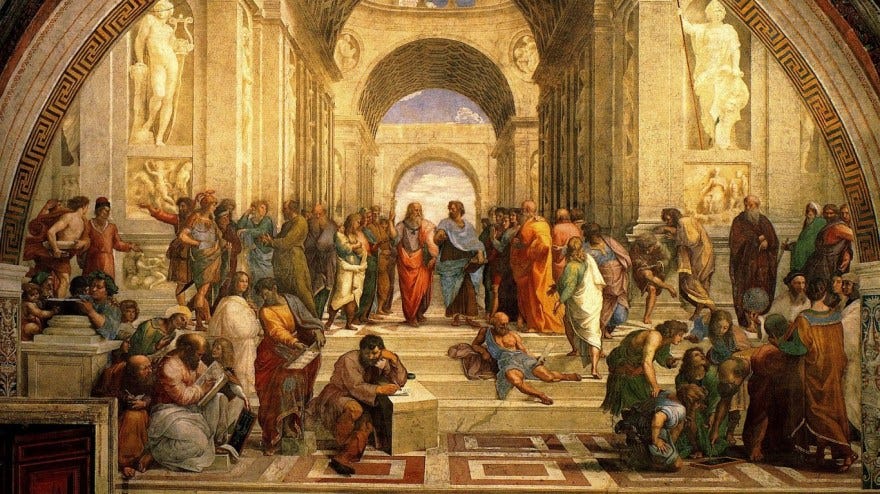
of that historic banquet of big ideas called The Great Conversation
We’ve probably all experienced that one particular uneasy moment whenever you’ve set the table for special company—that moment when the doorbell rings. We race through our mental checklists to make sure we didn’t forget anything, check our teeth for some stray piece of broccoli hanging around, and then open the door with a hearty smile to greet the guests.
Builders, artists, and teachers experience something similar when they create or build something for the public. In marketing lingo, to put something out into the world is to “ship it” (I’ve also heard “publish it.”) That uneasy moment always comes just before it’s time to ship—usually with your finger hovering over the “return” key.
Is this going to work? Will this help anyone? Will people care? Will I be able to cut through the digital noise enough that people will pay attention? Will people sign up for our conference? Will anyone buy and read my book? Will this course get enough traction to “green light”? Such moments are both scary and exciting!
The flip-side of that is equally true. There’s that moment you arrive somewhere as a dinner guest and press the doorbell. Are we dressed appropriately? Are we too early? too late? Is our hostess gift too banal? The same often goes for signing up for a course. Did I apply in time? Will this be a waste of time and money? Am I smart enough? Will they take me?
Well, we have arrived at such a moment.
Over the past several weeks, I have anxiously laid out—in the span of four videos—a case for The Great Conversation. If you have followed along as I set the table, you already know the argument. But there’s two things I have learned in more than thirty years of teaching: 1) usually only 5-10% get the lesson the first time, and 2) even then, the most persuaded often mistake conviction for decision (i.e., we really only believe what we act on).
Because of those two human obstacles, I want to gather all the flatware and cutlery and give them a final polish before getting everyone seated at the table. In laymen’s terms, I want to go over the details of this course together again, and lay out the plan for what happens next one more time.
To begin with, let me remind you where we have been.
In the first video, I offered you Dorothy Sayers’s image of the ship with watertight bulkheads—the tragedy of modern education that seals off every subject from every other subject, so that a student may learn a number of “subjects” but never learn the art of learning itself. I argued that since reality is not partitioned that way, neither should be your child’s education.
In the second video, I introduced the concept of the Great Conversation: the three-thousand-year-long, sustained conversation about the perennial questions relating to the human condition—the written records of the poets, philosophers, and prophets that Hutchins and Adler called the road to education. I also showed you the six-year arc we’ll be following, systematically organized around Adler’s six great ideas—Truth, Goodness, Beauty, Liberty, Equality, and Justice. Finally, I made the case that this conversation cannot be had in isolation. And, for the greatest success, it favors a cohort that begins together and finishes together.
In the third video, I went really practical: two ninety-minute Socratic seminars a week; thirty-two weeks a year; twenty-four high school credits across six years, covering all the humanities in an integrated fashion. Parents need only add mathematics, laboratory science, and physical education. I explained the graduated reading load, the writing progression, and the reason why continuity with a qualified teacher and Christian community matters more than any curriculum.
Finally, in the fourth video, I extended an invitation to interested families and explained the one feature that makes this course unlike nearly anything else you will consider: enrollment opens once and then closes for good. This is not a scarcity marketing gimmick; it’s just math. We won’t add students to the cohort along the way because the depth of the conversation in the later years depends entirely on who was present for it in the earlier years.
If you haven’t watched all four of the videos, they’re linked above. They would be worth 25-30 minutes of your time. As a matter of fact, because this is a six-year decision, I would encourage you to not fill out the interest form until you’ve watched them.
Next, here are a few details to be aware of:
I have to close the interest form on August 1st! (We start class on Aug 17th and will need time to interview every student, arrange for books, and secure supplies.)
I’ve opened 12 seats and 5 are already spoken for! (I cannot, for any reason, take more than 16 students. Once these seats are filled, the door to this cohort closes forever.)
This course is only open to the right 12-14 year-olds. (I am personally following up with every family who submits an interest form. We will have a real conversation where we talk candidly and I’ll try to answer all your questions.)
Finally, here’s what I would ask of you.
If you have a child, around twelve or thirteen, who is hungry for something real, who asks the hard questions, who likes to read, then don’t let this decision drift into the category of “things I meant to get around to.”
Take the two or three minutes to fill out the interest form. I will follow up personally, and together we will discern whether this course is the right fit for your child. If it’s not a good fit, I will gladly tell you so and point you in the right direction.
If this is the right fit—if you have one of those rare young people who is ready to sit at the table with some of history’s greatest thinkers (e.g, Homer and Moses, Plato and Paul, Augustine and Dante, Shakespeare and Dostoevsky, Lewis and Tolkien, etc.)—then I would count it a great privilege to spend the next six years making those introductions and picking their brains together.
The Great Conversation started nearly three thousand years ago. It’s a banquet of words and ideas that have shaped the Western world, and it’s just waiting for the next generation to take its seat at the table.
The table is nearly set. The invitation ends August 1st. Fill out the interest form today, and let’s talk about your child’s place at this historic banquet called The Great Conversation.


