
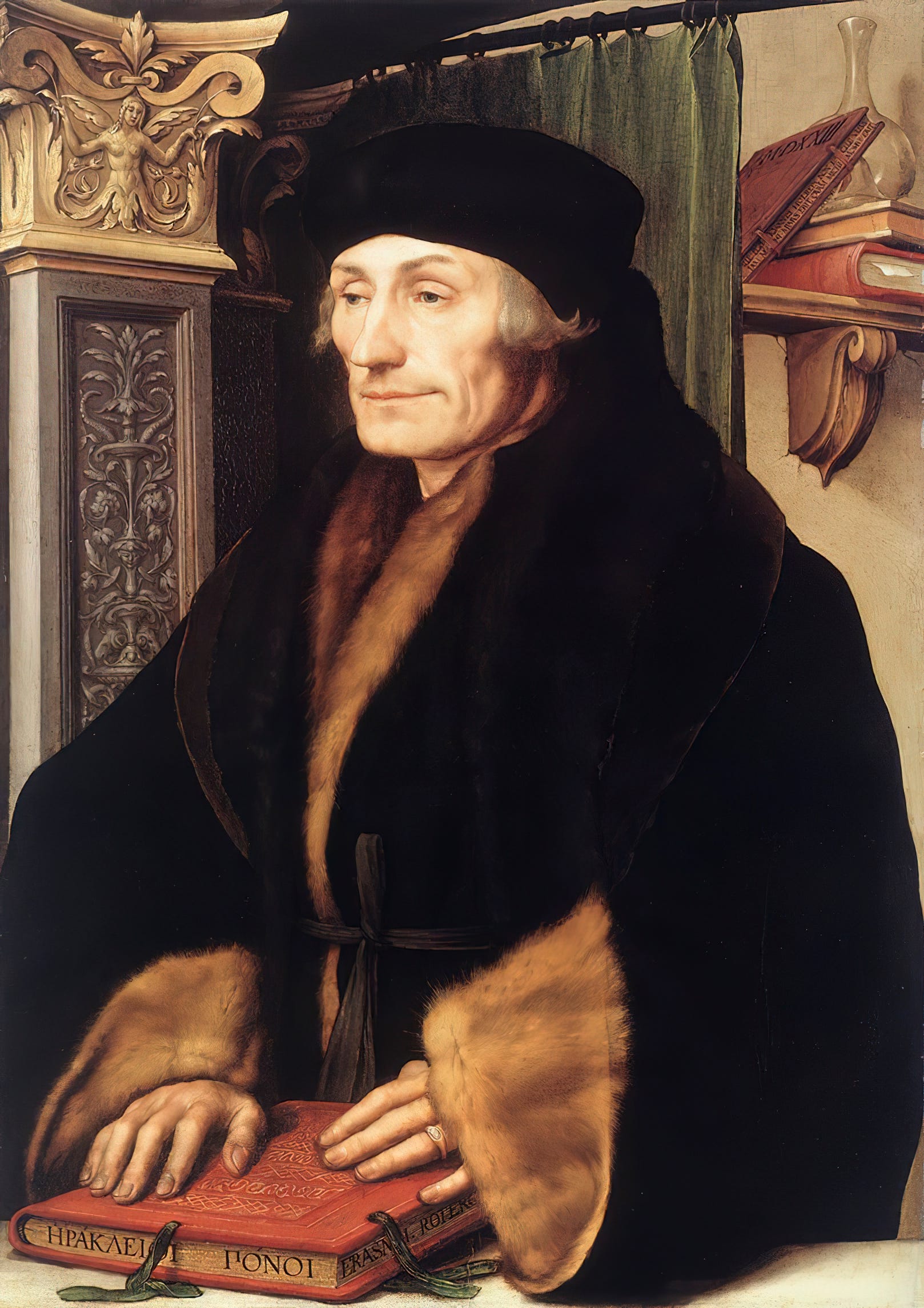
Second Epistle to the Prince of Humanists
A Christian Humanist Manifesto in the Form of Letters
Dearest Desiderias,
May the peace of Christ be upon you beloved Prince of Humanists.
Omnis gloria Deo for your most gracious epistle. Receiving your reply to my previous letter was balm to my soul. In a fit of melancholy, I had nearly resigned myself to believing I would never hear from you again, either because of our geographical distance or some exorbitant demands on your time—or, heaven forbid, one of those odious rumors of your untimely and mysterious demise were true. I’m ecstatic to be wrong on all counts. Your words have, once again, elevated my soul and given me heart.
Thank you for your kind and candid thoughts on the 10 Pillars For A New Christian Humanism I shared with you in my last letter. I will ruminate on your measured critiques and consider their application to this ambitious project. I am also taking your pointed warnings seriously, as you have urged me to do, especially the temptation to hold up Christ’s lordship as merely an intellectual axiom. God forbid! As your own philosophia Christi was that of simple piety and not any kind of ideological system—i.e., the best of Christianity is a life worthy of Christ—you have given me a faithful model I will strive to emulate. For that gift, I am deeply grateful to you.
Too, I will remember your wise admonition that kindness cannot supplant truth and that consensus is to be cherished over compromise. Furthermore, I will, when controversy arises as it did for you with Luther, let my arguments be candid but gentle just as you have advised me. I want you to be assured that I heartily agree with your wise assertion, which is just as important in my own day as it was in yours, to strive for unity rather than uniformity, all the while holding firm to the Apostle’s tradition.
Of course, I must humbly beg your pardon for so many careless assumptions I made previously. I should have been more mindful of the complexity of changes that have occurred since your prolific days of publication. No wonder you were perplexed at some of my statements and terms. Post-modern, for instance, describes the philosophical condition of the West now that secular humanism—with its emphasis on pure reason and its eschewal of religion—has run its course, a condition that had barely begun to take root in Rome and Florence when you were writing. In many ways, this post-modernism accounts for our current cultural malaise, a prevalence of nihilism and dysphoria that would nauseate you more than being forced to eat bad fish. I would unsettle you with the numerous anecdotes, but I must not divert too far from my purpose in writing this second letter.
I’m sure you will be surprised when I tell you, dearest Mentor, that many of your works are still being read today, especially Adagia, Colloquia Familiaria, and Encomium Moriae. And that doesn’t begin to account for the posterity of your Novum Instrumentum, which I shall say more about in due time. I inform you of this because you should know the effect your works have had on the entire Western world, a real Parnassus if you will refuse the impulse to believe I am merely flattering you. You will either be ecstatic or disconsolate to know still, all these years later, you are arguably the most notable, prolific, and influential scholar of the sixteenth century, both on the continent and in England. On one hand, your life’s work succeeded in manifesting the kind of Renaissance you and your beloved friends hoped to facilitate; but it also activated a revolution so significant that it set all of Europe on fire and turned the world upside down.
Your embittered exchanges with Luther? Your quarrels with the Louvain Divines? Your need to move from Louvain to Basel, and later fly from Basel to Freiburg im Breisgau? These were only the beginning of the unsettling of European Christendom. While you hoped discreet moderation would bring better progress in reform than impetuosity, it seems you failed to see just how wide the breach had become while you were propagating bonae literae. The contention between the papacy and Protestants eventually prompted Pope Paul IV to place your opera omnia on the Church’s Index Librorum Prohibitorum in 1559—more than twenty years after you ascended to your heavenly reward.
Oh, yes, dear Mentor, those theological debates grew Gargantuan, larger and more grotesque than even your brilliant mind could possibly imagine. Even though you adamantly preached a reform you hoped would transcend their immediate contest; it was not to be! Unwittingly, I’m sure, your works nevertheless participated in opening Aeolus’s bag of winds, the storms of which were unleashed on the complex webs of the Church and State politics of your day and forever changed the landscape of Christendom. And, of course, Luther’s intransigence (and hot temper) solum oleum in caminus addidit.
There is so much more I desire to tell you about the nearly five hundred years that have passed between us, but the changes are so monumental you would hardly recognize your beloved Europe, even our own vaderland. As you were acutely aware even then, the trajectory of the Italians sadly turned what was shaping up to be the most beatific renaissance of art and letters since Charlemagne into an unprecedented order of anti-theism. For my own part, you may be intrigued to know that four hundred years after you lived in the lowlands, mijn overgrootvader emigrated from Amsterdam to a nation that did not yet exist during the days of your burgeoning renewal. It is a nation that was established in Amerigo Vespucci’s “New World,” largely as a result of this Reformation your works helped ignite.
That work into which you most invested your heart, your Novum Instrumentum, which Frobenius published for you in 1516… Well, it would become an incendiary touchstone and the very basis for this Reformation of which I speak. Luther, as you well know, used it to translate his German New Testament in 1522. And perhaps you heard news of the English scholar by the name of William Tyndale. Certainly, you must have, even though he was nearly thirty years your junior if my memory serves me accurately. He studied at Cambridge just after you lectured there and was heavily influenced by the legacy of your dear friend, John Colet. In any case, this good man, Tyndale, was zealous for the gospel and in 1526 he translated your New Testament into his English vernacular. Unfortunately, he would pay for this “error” with his life the same year you also departed for the heavenly shores.
Ah, dear Mentor of Rotterdam! How can even Mount Vesuvius compare to the upheaval and change your Novum Instrumentum made on the world. Time and ink are too expensive to elaborate any more on this point now. It will have to be saved for another time. To summarize briefly, since I’ve undoubtedly shocked and frightened you with so many details. Suffice it to say your controversial magnum opus, matchless in its time, became the seedbed for what would to become known as the Textus Receptus, a work that served as the donor text for many new translations that were soon to follow: the Geneva Bible (1560), the Bishop’s Bible (1568), and King James’ Authorized English Version (1611). These all played their magisterial part in the Reformation that swept the Western world.
Good heavens, do pardon my digressio. How I have managed to occupy your precious time with minutiae far beyond my initial intentions. Yet, I beg your indulgence for another letter that must soon follow, seeing there is still so much to tell you. And, nevertheless, allow me to conclude my current lengthy epistle with an explanation as to where I have been forced to land on my feet in the current theological landscape.
Although I must disappoint you, and perhaps only by visiting our current state of affairs for yourself would you begin to understand my reasons, I must confess to being a Protestant, however careless I am for the label. If it were possible I would prefer to be called simply Christian; or, if need be, I would prefer Reformed Catholic, seeing I hold most sincerely to the true faith that was first delivered to the saints by our Lord and propagated by his apostles. Regrettably, even these descriptions themselves carry so much baggage due to all the historical wrangling; we must ever spend our days defining terms. To be sure, I find the most confidence for the status of my communion in Christ’s society in the language of our ancient brother, Saint Vincent of Lérins, who wrote in the Year of our Lord 434:
In the Catholic Church itself, also, great care is to be taken that we hold that which has been believed everywhere, always, and by all: for that is truly and properly Catholic, as the very meaning and derivation of the word show, which embraces all as nearly as may be universally. This we shall only then do, when we follow Universality, Antiquity, Consent. Universality we follow, by confessing that to be the one true faith, which the whole Church throughout the world professes. Antiquity, by in no wise receding from those senses which it is manifest that our holy elders and fathers generally held. Consent, in like manner, by adopting, in antiquity itself, such definitions and opinions as have been held by all, or at any rate, almost all, the priests and doctors together.1
I will expound on my own position more thoroughly in future correspondence but I can only hope to console you with the knowledge—for I expect you are greatly disappointed—that despite the bloody strife that occurred in the body of Christ in the subsequent years, many necessary reforms were achieved. Furthermore, you may be heartened to know that currently bits of conciliatory progress are slowly being made as well. For example, in the Year of our Lord 1999, A Joint Declaration on the Doctrine of Justification was established between the Roman Church and the Lutheran Church. I pray it is only the beginning of what a new Christian humanism would help foster. And that, if I may be so bold to remind you, is why I wrote to you in the first place.
I am perhaps most enthusiastic at this time about a modern renaissance in education and letters that is emerging amongst all the orthodox traditions represented in our day. Although distinct views on essential doctrines remain calcified within the ranks of our current communions, there is hope for a growing unity amongst those Christians of every tradition who are laboring in the trenches to restore classical education. If nothing else, this ecumenical work has served to partially reclaim a humane education for the next generation while also fostering congenial conversations about our various unique distinctions. Alas! Too much discord still remains.
Having full confidence in the mercy of our Redeemer that your soul has been certainly commended to God, I will, as I await your next letter, eagerly commend your wisdom to men. And if, as a confessional Protestant, I could ever muster the certainty of my Roman and Orthodox siblings, that our saintly brothers and sisters now abiding in Christ presence do, in fact, pray for us, I would ask you, Sancte Erasme ora pro nobis!
In constant hope of concord, I remain yours, most affectionately,
Agapetos Mathetes
If you are among those who already support my work, Thank you! I’m grateful for you. If you don’t yet support my work but receive some intellectual or spiritual profit from it, please consider supporting my work in one of the following ways.
Vincent of Lérins, The Commonitory of Vincent of Lérins (Baltimore: Joseph Robinson, 1847), 5–6.


Love these!