

I’m Writing from Copenhagen, Denmark
the first stop on a 29-day grand tour of Europe

This is a trip that my wife and I have been planning for nearly a year.
We arrived midday (Copenhagen time) and quickly learned to navigate the transit system without getting on any wrong trains or heading the wrong direction. Tomorrow we tour the Assistens Cemetery, the canals, and the Rosenborg Castle. Time will prevent us from visiting the National Museum, but we might make it Kronborg castle before our next stop, notable for inspiring Shakespeare’s Hamlet.
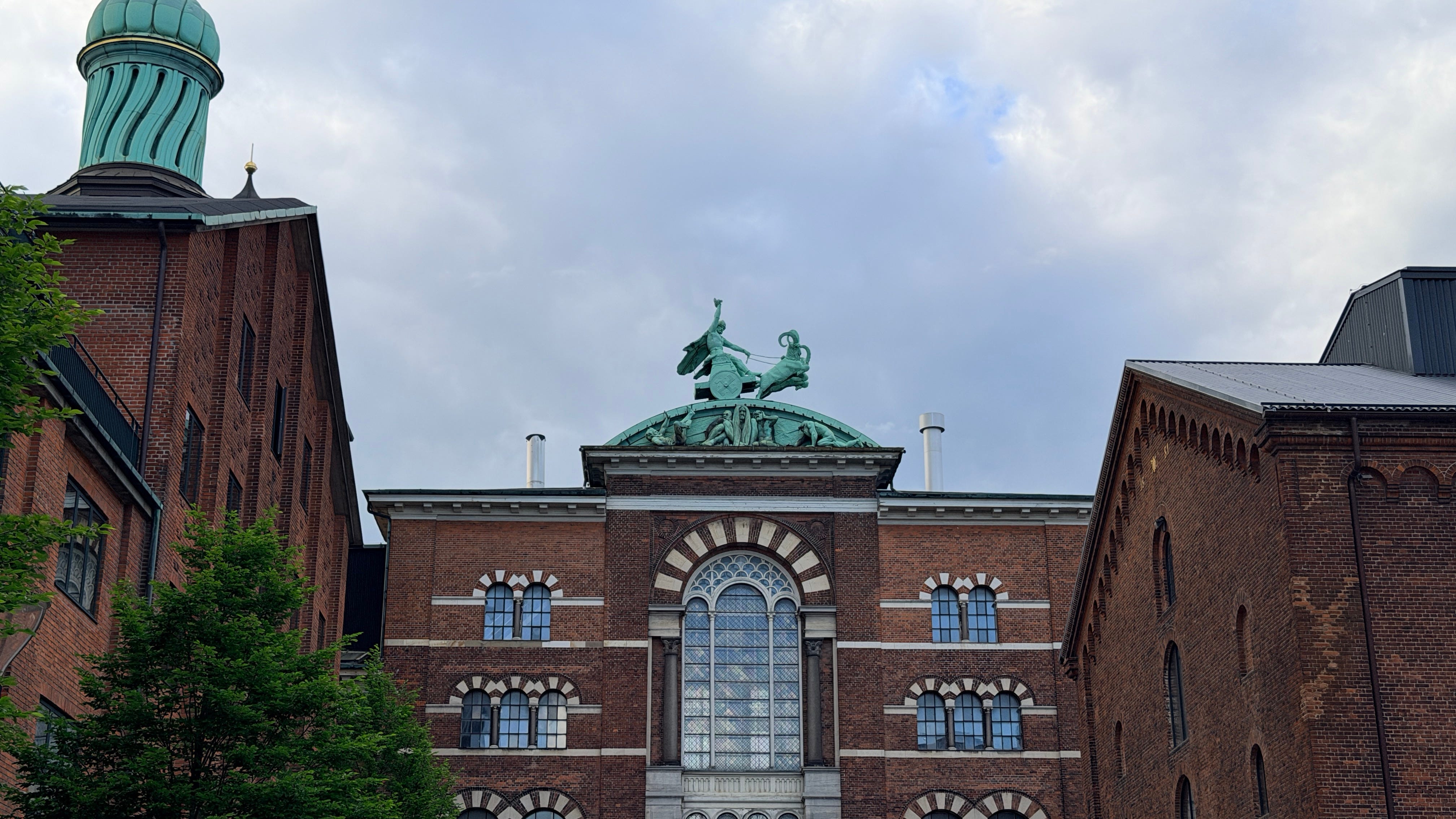
Later this week we’ll make our way to my ancestral homeland, Friesland, before heading to Amsterdam and Anderlecht. After that, we’ll meet up with Peco and Ruth Gaskovski and stand where Erasmus is buried in Basel, visit Calvin’s cathedral in Geneva, and spend a day at L’Abri in the Swiss Alps. After that, it’s Italy, Germany, and the UK. Along the way, we’ll visit Museums and browse antiquarian bookshops, behold cathedrals and frescos, and conclude our trip walking the medieval streets of York.
I mention all this not to try to make you jealous—although I understand if you are 😜—but because this trip is, in a very real sense, the course I’m teaching in July made visible. By the way, we are going to document as much of it as we can for you, because seeing the tradition in the flesh, in the places where it actually happened, is its own kind of argument for everything I’m about to mention.
A few days ago told you about a course I’m teaching this July: The Christian Humanist Reading Life. It’s a course based in part on my new book from Roman Roads Press, Becoming Classically Educated.

I want to follow up with this post to explain something I don’t feel I’ve been able to emphasize strongly enough before.
We live in a unique and troubling age, and age of unprecedented access to information and simultaneously an unprecedented poverty of wisdom. I mentioned previously that most of us feel this, even if we haven’t been able to put words to it. We are gorged on content; yet, somehow still starving. We have access to and consume more information than any generation in history and we understand less. In a real sense, we are knowledgeable beyond our wisdom.
The ancient philosophers had a word for the kind knowledge that actually matters, sophia (wisdom). Sophia is not information; it’s not credentials; and it’s not mere skills. In the past I have argued it’s the capacity to perceive what is real, to love what is good, and to live accordingly. Wisdom is the ability to answer the question, How should we then live? To answer that question we need to apprehend what reality, apprehend what is worthy of our sustained attention, worthy of prioritizing our loves for.
I must add that the great tradition of the West—from Plato to Polanyi—has, for all its disagreements, maintained with remarkable consistency, that wisdom is not accumulated knowledge. It is a cultivated art. It is planted intentionally and grows slowly over years of disciplined attention and approximation of one’s life to the right things.
What’s happened to us, culturally, in the estimation of those who study cognitive and moral development, is we’ve gotten stupider. We’ve been trained in efficiency by our screens, by our institutions, and by our economy to optimize for information retrieval rather than soul formation. We have been taught to scan rather than read. To consume rather than contemplate. To acquire knowledge rather than be transformed by it.
Consider, in the first place, how screens train humans to scan like machines. Content designers call it the “F scan”—that eye pattern we’ve all developed, skimming across the top of the page, down the left side, across the middle, quickly extracting what we need before moving on. The scan happens automatically: quickly and often unconsciously.
Where the act of reading presupposes that we are not machines.
Where screens train us to scan, the page trains us to commune, to converse, to contemplate. Where information fills the mind, wisdom forms the soul. And soul formation—the cultivation of a person capable of recognizing the true, loving the good, and being moved by the beautiful—is precisely what the modern world has eradicated in the name of efficiency and what the classical Christian tradition has always emphasized in the name of humanity.
Consider also that Josef Pieper argued that the totalitarian work state—a society in which human beings are valued only for their utility and economic productivity—is the direct consequence of our faulty understanding of leisure. We have confused it with recreation, entertainment, and amusement. All of those are things we do so we can return to work. Leisure, rightly understood, is something done for its own sake, something meaningful in itself, not as a means to something else.
The question Pieper left us with is the question this course is built around: What is worth doing for its own sake? If we cannot answer that question, we have not yet discovered the meaning of our existence.
So, in case you missed it or could use a reminder, The Christian Humanist Reading Life is six weeks of live, guided study on exactly that question. It’s not a course in abstract philosophical exercises; it’s a course in the practical formation of the habits of mind and heart that make human flourishing possible.
We begin July 7 and the course runs through August 11. It will take place over six Tuesday evenings, ninety minutes each, live with me at 5:00-6:30 pm PT. It’s capped at 13 students. The investment is $397. As part of your investment, you’ll receive a copy of Becoming Classically Educated.
If this is resonating with you—perhaps you’ve felt the restlessness Augustine describes, the hunger pains that information just doesn’t satisfy, the sense that your education gave you a great deal of facts and skills and yet somehow left the most important and perennial questions unanswered—then I want you in this course.
Reserve your seat before they’re all gone.
Please don’t mistake this as a high-pressured sales attempt. If you’re not asking these questions yet, or this is not resonating with you, then this course is not for you—at least not yet!
And if you have a question before you decide, questions about the course, the readings, or whether this is the right fit for you, personally, then email me@scottpostma.net and I will respond personally, even from Europe.
For wisdom, the great tradition, and the good life,
this is Scott Postma,
writing to you from Copenhagen, Denmark
P.S. C. S. Lewis once observed (in an essay titled, Learning in War Time) that humanity at its best has always found a way to pursue knowledge and beauty even under the most unfavorable conditions: in beleaguered cities, in condemned cells, advancing toward walls under fire. I might add: in the noise and distraction of the modern world. The only people who achieve much, Lewis says, are those who want knowledge so badly that they seek it while the conditions are still unfavorable. Summer is not an obstacle to the reading life. Summer is its invitation. And this course begins just as summer does.
Godspeed, my brother.