


Humanism is a “dirty” word to a lot of Christians. As a modern ethical posture, Humanism claims to promote social justice on behalf of the dignity of the human being. As a modernist philosophy, it emphasizes reason and naturalism, vehemently opposing the metaphysical, specifically the Christian faith and religion. Thus, the adjective “secular” is quite often added to clarify Humanism’s commitment to a naturalist view of the cosmos.
Before I discovered the little movement called Classical Christian Education, I understood Christianity and Humanism to be worldviews mutually exclusive of one another. But, I soon learned Secular Humanism is, historically speaking, an aberration; whereas, Christian Humanism is technically a redundant term, saying twice what really should only need to be said once. In other words, Humanism was Christian first!
My argument since has been that instead of despising the “dirty” word Humanism, Christians actually need to reclaim it. And, reclamation is not merely adding the opposing adjectival designator, Christian, to the concept of Humanism; we’re not creating another tidy sub-culture like contemporary Christians have done with so many other aspects of culture (e.g., Christian music, Christian art, and Christian fiction, etc.). We’re reclaiming what rightfully belongs to Christ and his Church.
The expression Christian Humanism came into use following the work of 19th-century German philosopher, Friedrich Niethammer (1766–1848), whose work sought to distinguish between two competing educational paradigms: Humanism and Philonthropinism. Philanthropinism emphasized utilitarian and practical education based on Enlightenment rationalism. Humanism, in his usage, referred to the Christian Renaissance tradition of holistic, formative education rooted in bonae litterae (‘Good Letters’) and the liberal arts.
The substance of Christian Humanism is much older than Niethammer, however. Jens Zimmermann, along with an abundance of additional scholarship, has carefully demonstrated that while the expression was coined later in history, the substance of Christian Humanism not only significantly predates secular, atheistic Humanism, but has existed since Christianity itself. Before the Incarnation, its inchoate forms sprang from a mixture of Hebrew Humanism and Greek Idealism; but it was the Incarnation that gave birth to Humanism.
Christian Humanism embraces the conviction that human nature is created imago dei (in the image of God), wounded by sin, and restored and perfected in the incarnate Christ. Thus, the Incarnation affirms the dignity of humanity and God’s lovingkindness toward mankind. And, while man is not the measure of all things, he is in the middle of all things—higher than the beasts and a little lower than the angels. Consequently, because all human beings are created imago Dei, they possess common grace, free agency, and individual conscience; humans are, therefore, creatures of immense worth, dignity, reason, and responsibility.
Thus, it follows that everything truly human, including reason, language, art, learning, and civic life, is to be received, cultivated, and ordered toward the Lordship of Christ. As Desiderius Erasmus wrote, “Everything in the pagan world that was valiantly done, brilliantly said, ingeniously thought, diligently transmitted, had been prepared by Christ for his society.”
In sum, the ethical posture of Christian Humanism is not man-centered but incarnationally centered; it holds that unencumbered rational inquiry is intrinsic in the doctrines of Christianity and not opposed to it; it holds the belief that tensions exist between faith, imagination, and reason are unfounded; instead, these faculties are a complementary and creative means for a flourishing human culture; it emphasizes a paideia unto the Lord in which the Christian Scriptures together with bonae litterae (the humane letters of the virtuous pagans) serve to form persons who are wise, eloquent, and holy; it maintains an allegiance to the Republic of Letters over and above mere national and ethnic boundaries.
Recovering Christian Humanism in our day will require faith, courage, and wisdom. But recovering it is obviously not enough. If it is worth recovering, it’s also worth defending. In Erasmus’s Antibarbarians, Jacob Batt, maps the battlefield for us quite well:
We shall therefore plead the cause of the old learning against its new opponents, and I see that the trouble comes mainly from three types of enemy. There are those who want the Republic of Letters to be destroyed root and branch. Others are doing their best to get its power not exactly extinguished, but restricted within narrower limits. Lastly there are those who want to see the republic preserved but utterly ruined, by themselves becoming tyrants, abrogating the laws of our fathers, and introducing foreign magistrates and behaviour.
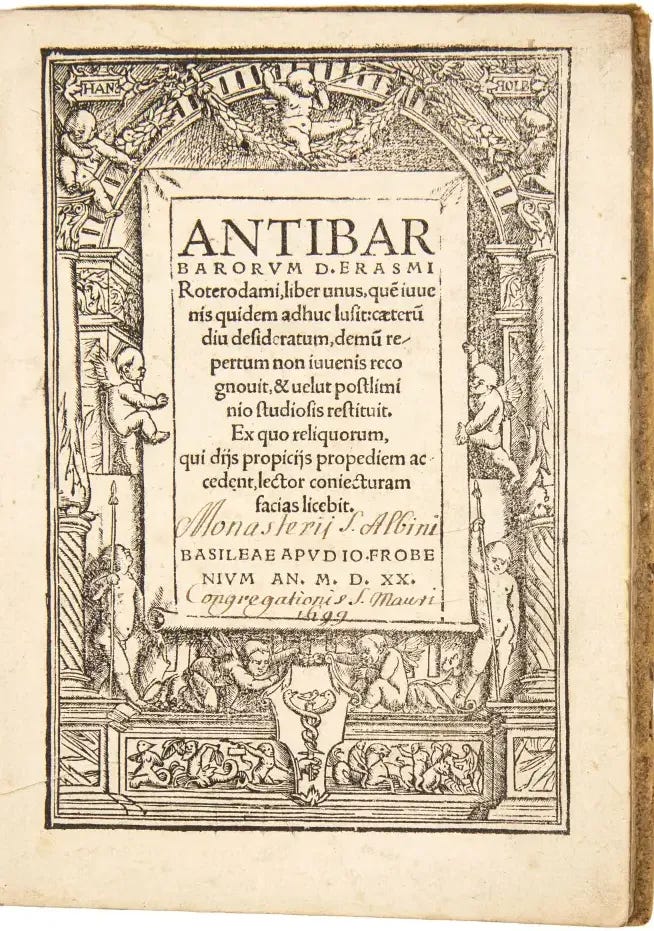
For Erasmus, there are three enemies of Christian Humanism. There are the destroyers, the reductionists, and the tyrants.
The destroyers want to eliminate the Christian Humanism root and branch. In Erasmus’s day, these folks saw the humanities as antithetical to the Scholastic’s logic-based education and—due to its use of profane texts (secular in modern terms)—poisonous to the Christian faith.
The reductionists (he calls them limiters) don’t feel the need to eliminate them altogether, but do want to limit and subordinate bonae litterae to their own “superior” curricula and pedagogy. The study of “good letters” can come after, if at all.
The tyrants refer to the mendicant orders of Erasmus’s day. He called them “beggars who rule,” uneducated men who sought to be in charge of schools for their own ambitious ends—petty tyrants. These are pretenders who advocate for humanism but only for their own ends and not the ends of good letters and human flourishing.
In subsequent posts, I’ll unpack these three enemies of Christian Humanism and reveal their hideouts and tactics in our modern landscape. Be sure to ❤️ this post and subscribe to get them delivered right to your inbox.