

Christianizing the Pagan, and Vitalizing the Dead
Christian Humanism and the Grotesque in The Ransom Trilogy

This paper was presented at the Ciceronian Society conference in Omaha on March 12th, 2026. It’s a longer post (about a 15-20 minute read) and is truncated in your email. Be sure to open it in your browser or the Substack App to read the entire paper.
The Hideous Strength holds all this Earth in its fist to squeeze as it wishes. But for their one mistake, there would be no hope left. If of their own evil will they had not broken the frontier and let in the celestial Powers, this would be their moment of victory. Their own strength has betrayed them. They have gone to the gods who would not have come to them, and pulled down Deep Heaven on their heads. Therefore, they will die.
—C. S. Lewis, That Hideous Strength, 291
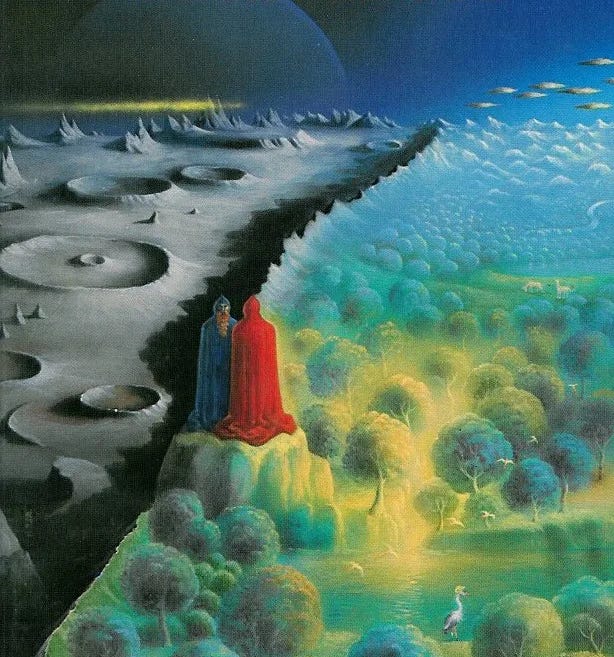
In the Cosmic Trilogy, C. S. Lewis employs the grotesque as a literary device that exposes the ontological failure of modern conceptions of “Life, Liberty and the pursuit of Happiness.” By way of his imaginative cosmology, Lewis reveals the ways in which reductionist views of man in nineteenth and twentieth-century Western thought had shifted the anthropological conversation from that of the seventeenth & eighteenth centuries which contemplated the “self-evident, inalienable rights endowed by [man’s] Creator” to the anti-humanistic philosophies of the twentieth century that had “removed the organ [of virtue] while still demanding the function.”
In response to the modernist’s subtle abolition of human heritage, Lewis reclaims these Enlightenment goods of Life, Liberty, and Happiness to accord with the Tao (i.e., objective values, natural law, norms, etc.) by Christianizing the pagan and vitalizing the dead.
To unpack my thesis in the time we have together, I would like to first consider the reductionist impulses of the nineteenth and twentieth centuries which were playing into the ontological failure of these Enlightenment goods, the growing crisis about the nature of man. Next, I’ll attempt to identify some contours of the grotesque to serve as a suitable definition as Lewis employed this literary feature. Third, we will consider Lewis’s diagnosis and recovery of the Enlightenment goods previously mentioned by his use of the grotesque toward a resacralized vision of the cosmos.
The Abolition of Man: The Reductionist Impulses of Modern Thought
Consider that in the Nineteenth century, Marx’s economic man refashioned the concept of liberty from being that of freedom from vice and ignorance in the service of a virtuous life to being freedom from economic and class oppression. Although Marx’s views on the alienation in the human condition created by the industrial revolution had merit, his project ultimately enslaves humanity by reducing human identity to that of oppressor and oppressed.
Similarly, Darwin’s works recast human ontology from being teleological to being merely biological. His reductionist approach reframed man’s purpose to being little more than mechanistic, instinctual, and survivalistic. Survival of the fittest is merely the propagation of the human species for the sake of propagating the human species. In Darwin, man devolves into abstraction and life descends into a meaningless ouroboros.
Next, Nietzsche extends Darwin’s biological conception of humanity to that of morality; ironically, in doing so, he reduces man to the ubermunch, the superman. Since Nietzsche ultimately locates morality in the will to power, modern man’s dynamistic impulse is thus crystalized into an ethos of force (i.e., “might makes right” and “culture wars”).
Finally, Freud went a step further in the devolution of reductionist conceptualizations and gave modernity a psychological man—a head without a chest or belly. Instead of the pursuit of self-mastery in the service of the good life—the activity of the soul in accordance with virtue, eudaimonia (or happiness)—“psychic equilibrium” became the means of happiness.1 For Freud, the discovery of repressed thoughts and emotions and the subsequent therapeutic treatment of one’s guilt is the key to human flourishing.
In The Abolition of Man, Lewis famously warns against the modernist ambition to conquer nature and sever morality from its foundation in natural law (or, the Tao) like these nineteenth & twentieth century thinkers have done. He unpacks a process whereby this secular progressivism ultimately dehumanizes man by reducing him to mere materiality and enslaving him to subjectivism. For Lewis, the Tao is the real basis for life, liberty, and human flourishing because man’s conquest of nature turns out to be man’s conquests of other men using nature as his instrument. These conquerors, he calls them conditioners, are actually themselves enslaved to their baser desires (i.e., Nature).
While Lewis’s recovery of the Tao in his prose work is an eloquent and cogent critique of the failures of modernism in this respect, it provides the theological and philosophical framework for his imaginative literature—especially in his Cosmic Trilogy—which dramatizes the consequences of these reductionist ideologies with compelling force. Lewis’s imaginative work explores how this long train of reductionism resulted in the ontological failure of these Enlightenment goods. For Lewis, this also means that society, if it does not recover fidelity to the Tao, will culminate in a dehumanized and demonic technocracy. It is an uncanny prognosis given post-modern developments that have emerged since his death.
He begins unpacking these consequences in Out of the Silent Planet, where he shows that life for life’s sake, that is life divorced from its creatureliness—its transcendent telos—results in sheer survivalism, the mere perpetuation of the species. He further shows in Perelandra that liberty disconnected from obedience, happy submission to the Creator, reduces to demonic possession. Although this perspective is abrasive to the secularist whose project is the elimination of the supernatural from public life, Lewis demonstrates such reductionism becomes grotesque. Finally, in That Hideous Strength, he shows that the pursuit of happiness devoid of virtue and universal moral norms culminates in the conquest of human flourishing. Or, as he expresses it in his Abolition of Man, “Man’s conquest of Nature turns out, in the moment of its consummation, to be Nature’s conquest of Man.”2
The History and Meaning of the Grotesque
Wolfgang Kayser suggests that “as cleavages develop in society, grotesque distortions appear as the harbingers of cultural renewal.”3 Thus, it is apropos that Lewis is able to leverage the grotesque in his imaginative literature, and use it like a proverbial megaphone to engage the mind and spirit of his readers to bring them to “a state of awareness that will permit no evasion.”4
In modern analysis, the grotesque is rarely thought of “beyond the rather vague terms ‘strange,’ ‘incredible,’ ‘unbelievable.’”5 Despite the fact “it is relatively easy” to recognize the grotesque in a work of art, defining it remains curiously elusive; and apprehending it directly is rather difficult. So given our limited time, we will have to be satisfied with a truncated history and a working definition of this uncanny literary feature.
At the outset, we can establish that as an artistic and cultural form, the very presence of the grotesque in any work of art is meant to place all tacit assumptions we have about ideas in doubt.6 In other words, the very Ding an sich of the grotesque is characterized as “a species of confusion,”7 and its artistic power lies in its ability to “arrest the reader’s attention” while leaving “his understanding unsatisfied.”8
The term grotesque first entered the vernacular of the West in Italy around the sixteenth century. Its etymological origin is from “grotta (cave).”9 The term was coined “to designate a certain ornamental style which came to light during fifteenth-century excavations of Nero’s Domus Aurea (Golden House) and the baths of Titus” in Rome. It is noteworthy that these artistic features were not only controversial during the Renaissance, the were so when they first appeared in ancient Rome, rousing the disapproval of Vitruvius, the first-century B.C. Roman Architect, who bemoaned them as “paintings of monstrosities.”10
Yet, what Vitruvius had viewed as monstrosities were seen by many Renaissance artists, like Georgio Vasari, Pinturicchio, and Raphael, as caricatures of the real world that playfully subverted the natural order of things. Thus, the artistic concept of the grotesque emerged in the modern world as a specific ornamental style adopted from Pagan antiquity. It was “not only something playfully gay and carelessly fantastic, but also something ominous and sinister…in which the realm of inanimate things is no longer separated from those of plants, animals, and human beings, and where the laws of statics, symmetry, and proportion are no longer valid.”11
Following its discovery in Italy, its definition expanded at a time in history when the use of satire–particularly, caricature–began to be accepted as the “basis for meaningful and substantial art.” The use of the grotesque, then, naturally extended to “literary phenomenon…architecture…dance, and a form of lettering that was sometimes confused with Arabesque or Moresque art,12 the ornamental art of merging of tendrils and leaves.13
For all its expansive complexity, we can, for our purposes, now draw from some of the chief scholars on the grotesque to formulate a helpful conceptual definition, or at least an understanding of its contours.
First, we can say the grotesque is “an esthetic category” without a “well-defined category of scientific thinking;”14
second, as “an aesthetic phenomenon,” it encourages the creation of meaning and the discovery of new connections through its effect of shock, confusion, disorder, or contradiction.”15
third, it is an art whose form and subject matter appear to be a part of, while contradictory to, the natural, social, or personal worlds of which we are a part, it’s a form whose images most often embody distortions, exaggeration, or a fusion of incompatible parts in such a fashion that it confronts us as strange and disordered, as a world turned upside down.16
Fourth, it is a kind of caricature in which the artist “disregarding verisimilitude, gives reign to an unchecked fancy with the sole intention of provoking laughter, disgust, and surprise… by the unnatural and absurd products of his imagination.”17
Finally, the grotesque is licentious fantasy, a departure from art that is generally “regulated by measure, order, and rule.”18
Lewis’s Use of the Grotesque as Cultural Diagnosis and Recovery
(with an emphasis on its use in Out of the Silent Planet; I treat the other novels more fully in other papers)
Lewis uses the grotesque in various ways to highlight the state of human flourishing—life, liberty, and the pursuit of happiness—when it’s divorced from one’s creatureliness. As a Christian humanist, Lewis redeems the grotesque (he Christianizes it) to evoke both shock and revelation, demonstrating the dehumanizing effects of a world estranged from natural law and Divine revelation.
For Lewis, the grotesque serves as a pedagogical device that reveals the chasm between the distorted modern self and the fully realized human being, one whose affections are rightly ordered under the Tao. This effect is potent because, as was mentioned previously, the grotesque “arrests the reader’s attention yet leaves his understanding unsatisfied.”19
For Lewis, the grotesque forces the reader into a confrontation with disturbing realities but does not provide immediate resolution or catharsis. Instead, Lewis leaves the reader in a state of existential uncertainty, mirroring the unresolved spiritual crises of the characters, before ultimately guiding the reader toward a redemptive vision of humanity.

Malacandra
We are going to spend the majority of our remaining time making our analytic overview in Out of the Silent Planet where Lewis sets the stage for challenging the ethos of secular scientism. Before I conclude, I’ll briefly mention correlations to the second and third books where the use of the grotesque also plays a significant role.
Lewis presents the secularism of modern thought through two characters, Edward Weston and Dick Divine, who kidnap his protagonist, Ransom, a university don and philologist who is on a walking tour, for the purpose of offering him as a sacrifice to what these modern men believe are the primitive inhabitants of Malacandra (the Old Solar name for Mars).
Weston is a physicist who is driven by the abstract notion of perpetuating humanity at any cost—even the lives of individual human beings—builds a space ship he hopes to use to colonize other planets. Despite Lewis’s penchant for decrying allegory, Weston is, nevertheless, allegorically Western civilization. His partner, Dick Divine, is a disagreeable and bellicose former schoolmate of Ransom’s who has invested in Weston’s scientific research with the unequivocal goal of gaining wealth and luxury for himself at any cost.
The reader is introduced to the modern ethos of science in the service of secular humanism through the desires and dialogue of Weston and Divine who are literally hellbent on the absolute perpetuation of the species through planetary colonization. Through the relationship of these two characters, Lewis cleverly illustrates the co-belligerent nature of ideological modernism—the sensual embrace of scientism and hedonism.
These dynamics are presented early in the novel when Ransom stumbles onto their criminal activity; discovering the don is on a walkabout where he won’t be missed for months, Devine persuades Weston to take Ransom as their hostage instead of an idiot boy they are in the process of kidnapping. For Weston, an individual’s inherent value is based merely on his capacity for reason. In his estimation, the idiot boy wasn’t fully human, merely “a preparation,” while Ransom was “after all, human.” Here, secularism divorces human life from its creatureliness—its intrinsic value rooted in transcendent telos.
In a conversation with Ransom that takes place on the space ship en route to Malacandra, Weston tells Ransom he is aware that he has infringed on his rights, but his seeming injustice is indeed justified in light of the enormity of their project: “small claims must give way to great,” says Weston.20 He then contends that Ransom “cannot be so small-minded as to think that the rights or the life of an individual or of a million individuals are of the slightest importance in comparison” with the greatness of his enterprise.21 For Lewis, secularism’s ethos is a mixture of idealistic scientism and pragmatism; it is reduced to “might makes right” all over again.
On the planet Malacandra, Lewis contrasts the secular wisdom of Weston and Divine with the Old Solar wisdom of the grotesque inhabitants of Malacandra. Here Lewis’s grotesques are rather mild. Yet, they intensify with each stage of his literary development. In this first novella, the primary grotesques are the planet of Malcandra and the three sentient beings (Hnau): Seroni, the Hrossa, and the Pfifltriggi.
The planet is described as “beautiful,” but also unnatural; a “fantastic sublime.22 For example, “the water was not merely blue in certain lights like terrestrial water but ‘really’ blue;” and its waves are described as “wrong or unnatural…too big for such a wind…the wrong shape…far too high for their length, too narrow at the base, too steep in the sides.”23 The mountains were “jagged and irregular…too thin and steep for mountains…like the jagged teeth of a giant—a giant with very bad teeth.”24 Clouds were “rose-colored…and very solid-looking…like the top of a gigantic red cauliflower.”25 And, there were purple forests of vegetables forty feet tall with slender, flimsy stalks, and leaves as large as boats that were nearly transparent, corresponding roughly to Ransom’s idea of a submarine forest.26
In short, while the planet Malacandra as a grotesque is not ominous or sinister, it categorically and unquestioningly fits the description provided by our scholars. The three sentient beings that occupy Malacandra living in what we might consider political harmony under the benevolent rule of the Oyarsa, are also mild grotesques: The Séroni are philosophers; the Hrossa are hunter-poets; and the Pfifltriggi are craftsmen and artisans.
The Séroni live in the big caves of the high country (harandra).27 They look like ogres, ghosts, or skeletons. They are “Spooks on stilts…surrealistic bogy-men with their long faces…madly elongated.”28 Ransom further describes them as possessing a “giant stature…cadaverous leanness [and a]...long, drooping, wizard-like profile... The head appeared to be narrow and conical; the hands or paws with which it parted the stems before it as it moved were thin, mobile, spidery and almost transparent.”29
The Hrossa live in the handramit, a network of canal beds, and its features are:
a coat of thick black hair, lucid as sealskin, very short legs with webbed feet, a broad beaver-like or fish-like tail, strong fore-limbs with webbed claws or fingers…something like a penguin, something like an otter, something like a seal; the slenderness and flexibility of the body suggested a giant stoat. The great round head, heavily whiskered, was mainly responsible for the suggestion of seal; but it was higher in the forehead than a seal’s and the mouth was smaller.30
The pfifltriggi are “frog-like animals—or tapir-headed animals.” They are also described “as reptilian, like grasshoppers, and frog-like; small and hairless; having many fingers and making a rasping sound when it moves and having a piping laugh; they are matriarchal and short-lived; they live in the forests and mines on Malacandra’s old ocean beds; they are the craftsmen and artisans, the makers.”31 Lewis captures the essence of the work the grotesque performs in his cosmic trilogy when he narrates the following:
It was only many days later that Ransom discovered how to deal with these sudden losses of confidence. They arose when the rationality of the hross tempted you to think of it as a man. Then it became abominable—a man seven feet high, with a snaky body, covered, face and all, with thick black animal hair, and whiskered like a cat. But starting from the other end you had an animal with everything an animal ought to have—glossy coat, liquid eye, sweet breath and whitest teeth—and added to all these, as though Paradise had never been lost and earliest dreams were true, the charm of speech and reason. Nothing could be more disgusting than the one impression; nothing more delightful than the other. It all depended on the point of view.32
Note Ransom’s “sudden loss of confidence…and the presence of both disgust and delight in the same image. Lewis is describing the effect of the grotesque, not only on Ransom, but also on his reader. In an unfallen world, the grotesque reveals the fantastically sublime nature of the created order–and it does so over against the progressive scientism of modern men. Thus, the grotesque serves to resacralize the modern man’s vision of the universe.
Lewis’s use of the grotesque is not insignificant because the union of Christian faith and classical humanist principles is not an artificial one. Like the marriage union, the two are actually one. Similar to the original ornamental grotesques, Christian humanists like Lewis recognize the Incarnation of Christ has so fused divine purposes with the human that it is nearly impossible to decipher where the one ends and the other begins. For example, the various early Church controversies surrounding the heresies of Monophysitism and Monothelitism can attest to the difficulty in articulating the distinction between divine and human natures joined by hypostatic union.

Perelandra
In his novel, Perelandra, the “Un-man” serves as the predominant grotesque. He is described by philosopher Richard Purtill as “one of the most chilling representations of sheer evil in literature.” Lewis’s duplicitous antagonist is grotesque because he is demonic—both man and devil, natural and uncannily supernatural. He is the ultimate and demonic division of the self against the pure and innocent backdrop of a paradisiacal, unfallen world. He is ludicrous and terrifying at the same time.
Here we see how the grotesque serves to show its opposite, the soul of man separated from his source of vitality. The Un-Man is a being whose humanity is entirely subsumed by diabolical will, a horrifying vision of what man becomes when he divorces himself from the divine order and enters what David Eggenswhiler calls “a sustained and compulsive denial of reality.”33 Unleashed on prelapsarian Venus, The Un-man demonstrates the end of the modern man’s pursuit of an autonomous self—the Abolition of Man set in Deep Heaven. By giving the world “the Un-man,” Lewis writes large that which tends to exist unnoticeable in a modern world that resembles T. S. Eliot’s Waste Land.

Thulcundra
In That Hideous Strength, Lewis’s story takes place on Thulcundra, the silent planet (earth), and centers in the areas of Bracton College (at the University of Edgestow), Bragdon Wood, St. Anne’s (Logres) and Belbury. In this novel, the grotesque reveals the culmination of the modernist ideology that has attempted to abolish man altogether.
Belbury, whose name is a play on Babel, is the headquarters of the N.I.C.E. (The National Institute for Coordinated Experiments) and represents hell on earth. The grotesques are seen in the deputy director of the N.I.C.E., John Wither, The “Fairy” Hardcastle (a butch dyke in charge of the private police), and ultimately, “the Head,” the severed and reanimated head of a French scientist named François Alcasan, who had been guillotined but kept alive by Dr. Filostrato (the head is actually possessed by demonic forces called Macrobes).
Here, pure reason and the “science” of the modern progressive element ends up leaving behind real scientific inquiry for the diabolical. In making an idol of “science backed by the full force of the state,” they end up worshiping demons. Theirs is the ultimate end, the complete abolition of man, in his most grotesque state.
An attempt to eliminate the chest by sterilizing nature and pursuing pure reason culminates in demonic worship. In the end, their language is undone, the animals (i.e., Nature) become instruments of judgment on their evil enterprise of technocratic tyranny, and the evil ones are all executed. They bring Deep Heaven down on their heads.
Lewis Christianizes the Pagan by sacramentalizing the ancient and medieval conceptions of the cosmos and revitalizes the dead to restore order. The Planets of medieval and pagan myth, along with Merlin, the real faerie, are incarnational aspects of the Christian Divine.
By situating Lewis’s use of the grotesque within the broader tradition of Christian humanism, one is able to readily conceptualize what Flannery O’Connor called an anagogical vision—a glimpse of the numinous at work in the material world—something we might think of as a sacramental view of the world, where the supernatural participates in the natural.
Interestingly, Lewis’s prose work focuses on cultural recovery via the Tao, but his imaginative literature goes a step further and exposes the consequences of rejecting the Divine Life while simultaneously illuminating the possibility of grace (e.g., Mark and Jane Studdock); thus, he recovers a teleological view of man by reaffirming his telos in Christ.
Lewis’s use of the grotesque, then, is not simply a narrative device; its employ is designed to startle the reader into an encounter with the transcendent. For Lewis, the grotesque is an invitation—startling, sometimes terrifying, but ultimately a hopeful invitation—to rediscover what it means to be truly human.
More profoundly, grotesques for Lewis function diagnostically. They compel modern readers to confront their own modernist malformation while simultaneously illuminating the divine remedy for human flourishing. That means life, liberty, and the pursuit of eudaimonia can only be rooted in the love and life of God alone. Only submission to the Triune God’s Tao can restore humanity to its intended glory as bearers of the imago Dei.
Psychic equilibrium is the state of balance achieved when the ego properly manages conflicting demands from the unconscious pleasure impulses of the id, the moralism of the superego, and external reality.
C. S. Lewis, The Abolition of Man or Reflections on Education with Special Reference to the Teaching of English in the Upper Forms of Schools (HarperOne, 2001), 68.
Wolfgang Kayser quoted in James Luther Adams and Wilson Yates, eds., The Grotesque in Art and Literature: Theological Reflections (Grand Rapids, MI, MI: W.B. Eerdmans, 1997), xiii.
Adams and Yates, The Grotesque in Art and Literature, xiii.
Kayser, The Grotesque, 17.
Regarding the tacit assumptions we have about ideas, Harpham asserts: “as a practical matter we commonly adhere to several tacit assumptions about ideas: that they can be clearly expressed; that they have kernels or cores in which all is tidy, compact, and organized; and that the goal of analysis is to set limits to them, creating sharply defined, highly differentiated, and therefore useful concepts. We assume that however complex an idea may be, it is essentially coherent, and that it can most profitably be discussed in an orderly and progressive way.” Harpham, On the Grotesque, xvi.
Geoffrey Galt Harpham, On the Grotesque: Strategies of Contradiction in Art and Literature (Princeton, NJ: Princeton University Press, 1982), xv.
Harpham, On the Grotesque, 3.
Kayser, The Grotesque, 19.
“For instance, reeds are put in the place of columns, fluted appendages with curly leaves and volutes, instead of pediments, candelabra supporting representations of shrines, and on top of their pediments numerous tender stalks and volutes growing up from the roots and having human figures senselessly seated upon them; sometimes stalks having only half-length figures, some with human heads, others with the heads of animals.” Vitruvius Pollio, Vitruvius: The Ten Books on Architecture, ed. Morris Hicky Morgan (Medford, MA: Oxford University Press, 1914), 211.
“This meaning ensues from a synonym for grotesque which came into usage during the sixteenth century: the dreams of painters (sogni dei pittori).” Kayser, The Grotesque, 21-22. Kayser’s note that early grotesques suggested “something ominous and sinister in the face of a world totally different from the familiar one” has deep roots in the understanding and artistic employment of the grotesque. Alison Milbank, God and the Gothic: Religion, Romance and Reality in the English Literary Tradition (Oxford, UK: Oxford University Press, 2018), 1. Milbank suggests Gothic literature, of which grotesque is a standard feature, depicts the “diachronic tension” between the natural and supernatural, oppression and emancipation, between the contemporary new Protestant world and the antiquarian Catholic world. Amanda Turnbull remarks that “hints of the grotesque in American writing can be seen among the earliest recordings of the American experience by William Bradford and Mary Rowlandson, showing the sense of alienation felt by early settlers in a land they found to be far different than expected. Amanda Turnbull, “The Psychological Grotesque in Modern American Literature,” Rollins Scholarship Online, 2018, https://scholarship.rollins.edu/mls/81?utm_source=scholarship.rollins.edu%2Fmls%2F81&utm_medium=PDF&utm _campaign=PDFCoverPages, 1.
Kayser, The Grotesque, 17. John Flemming and Hugh Honour rightly note that “Human figures are not used [in arabesques] as they are in GROTESQUES.” John Fleming and Hugh Honour, The Penguin Dictionary of Decorative Arts (Harmondsworth, UK: Viking, 1989), 33.
Arabesque is a style of ornamental patterns that use perspective to compose “more realistic shoots, leaves, and blossoms,” while Moresque is merely a two-dimensional style of similar displays of ornamental tendrils and leaves.
Kayser, The Grotesque, 17.
Susan Corey, “The Religious Dimensions of the Grotesque in Literature: Toni Morrison’s Beloved,” in The Grotesque in Art and Literature: Theological Reflections, ed. James Luther Adams and Wilson Yates (Grand Rapids, MI: William B. Eerdmans Publishing Company, 1997), pp. 227-242, 229.
Wilson Yates, “An Introduction to the Grotesque,” in The Grotesque in Art and Literature: Theological Reflections, ed. James Luther Adams and Wilson Yates (Grand Rapids, MI: W.B. Eerdmans, 1997), pp. 1-68, 2.
Kayser, The Grotesque, 30.
Adams and Yates, “An Introduction to the Grotesque,” 8.
Geoffrey Galt Harpham, On the Grotesque, 3.
C. S. Lewis, Out of the Silent Planet, Space Trilogy (HarperCollins Publishers, 2012), 29.
C. S. Lewis, Out of the Silent Planet, 29.
C. S. Lewis, Out of the Silent Planet, 54.
C. S. Lewis, Out of the Silent Planet, 43-44.
C. S. Lewis, Out of the Silent Planet, 44, 105.
C. S. Lewis, Out of the Silent Planet, 44-45.
C. S. Lewis, Out of the Silent Planet, 45.
C. S. Lewis, Out of the Silent Planet, 70.
C. S. Lewis, Out of the Silent Planet, 49.
C. S. Lewis, Out of the Silent Planet, 54.
C. S. Lewis, Out of the Silent Planet, 55.
C. S. Lewis, Out of the Silent Planet, 70, 112; Christiana Hale, Deeper Heaven, 315.
C. S. Lewis, Out of the Silent Planet, 59.
Harpham explains that “grotesque form is a material analogue or expression of spiritual corruption or weakness,” because the “soul” is the “organizing spiritual principle, the source of structure and order,” when one falls from grace, “the rebels [are] distorted…having surrendered their structural integrity and formal coherence in the act of transgression.” Harpham, On the Grotesque, 7. Eggenschwiler proposes the argument—truncated for our purposes—that a “whole man” being a “synthesis of the divine and the earthly” is to some extent free otherwise he would be relegated to natural law (i.e., psychology would replace ethics since man is not responsible for his “natural” actions). And since, from a Christian humanist perspective, this could never be the case, otherwise man would cease to be a man, he is to some extent free. And being free, in Kierkegaardian terms he experiences dread. He is ultimately left with two choices as a response to his dread—trust God and accept his condition and place in the world, or “sin” by attempting to escape that dread by his own means. Since the latter choice would ultimately be idolatry (not atheism) and, idolaters, are in effect, participating with or possessed by demons (1 Cor. 10:20), man who turns from God is demonic. Inevitably, this results in a continual process of despair and estrangement. Eggenschwiler, notes that “demonic activity must be a sustained flight from dread and freedom, a sustained and compulsive denial of reality; but since the object of worship is finite, it is not adequate to support its deification, and it must fail the worshiper, returning him to the anxiety that has always been haunting him just outside the edge of his neurotically limited attention.” Eggenschwiler, The Christian Humanism of Flannery O’Connor, 31-33.